
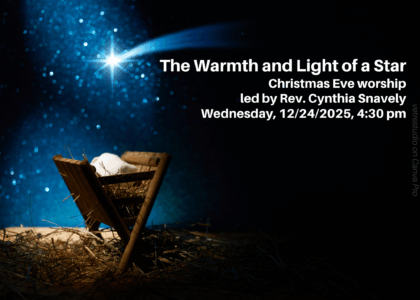
Please click the link to watch Rev. Cynthia Snavely’s video recording of this sermon.
What is the first song you learned? If it was not the first, I bet this one was among the first: “Twinkle, twinkle, little star, How I wonder what you are. Up above the world so high. Like a diamond in the sky. Twinkle, twinkle, little star, How I wonder what you are?” I know it was the first song my sister learned to play on her violin.
Star, what are you? Over millennia we have answered that question in many ways. Perhaps you were told that stars were babies waiting to be born or the dead now watching over us from the sky. Or that the “moving stars,” the planets, were gods and goddesses; Mercury, Venus, Mars. The stationary stars moving in groups across the sky were said to be bears, archers, queens, hunters, twins, dogs, rabbits, pigs and more, all for some reason cast into the sky.
What is a star? Today we know the science of a star’s composition, we know they are gathered in groups called galaxies, we know they often have planets orbiting them in solar systems, but they still instill a sense of wonder in most of us. How many stars are in the sky? They seem innumerable. How did our own star, our sun, end up at just the right distance and strength to allow us to come into being?
In the back of our hymnal is a piece by Unitarian Universalist minister Robert Weston that begins:
“Out of the stars in their flight,
out of the dust of eternity,
here have we come,
Stardust and sunlight,
mingling through time and through space.
and ends:
“This is the wonder of time;
this is the marvel of space;
out of the stars swung the earth;
life upon earth rose to love.
“This is the marvel of life,
rising to see and to know;
Out of your heart, cry wonder:
sing that we live.”
Weston tells the story of the birth of all life on this planet, but tonight we tell the story of a star coming into being to announce the birth of one particular life. We know this story told tonight of a star appearing and leading magi, wisemen who knew the stars, to a child in Bethlehem.
New stars appearing have often been given meanings for our own lives. The Encyclopedia Britannica tells of a new star a millennia after this night’s storied one: “In late April–early May 1006, a supernova appeared in the constellation of Lupus. It was about as bright as a crescent moon and was recorded from Switzerland to Egypt and even possibly by the Hohokam of Arizona. In China some interpreted it as ominous. However, one astronomer, Zhou Keming, put the opposite spin on the situation. He told the emperor it was an ‘auspicious star’ and ‘would bring great prosperity.’ Zhou asked the emperor to command his officials ‘to celebrate the occasion to calm the people.’ The celebrations were a success, and Zhou was promoted to librarian and escort of the crown prince,” (from 9 Celestial Omens | Britannica).
We are the ones who give earthly meaning to the stars. In tonight’s story, the magi saw the star as auspicious. Herod saw it as ominous. Do you read your horoscope in a weekly advertiser and on Chinese restaurant placemats? Even if you have no belief in astrology, I bet many of you do and that you know your signs. I know I was born under the sign of Virgo in the western zodiac and under the sign of the Pig in the Chinese zodiac.
When I googled Virgo horoscope December 2025, this is what I got:
“In December 2025, Virgo can expect a month focused on home and family…. Overall, December is a time for Virgo to prioritize personal matters and create a stable foundation for the year ahead.” Obviously, that is generic enough that I can read whatever I want into it. I am the one making meaning in my life not the stars.
We are the meaning makers. For Christians, the child of Isaiah 9 is Jesus. The New International Version English translation of the passage reads, “The people walking in darkness have seen a great light; on those living in the land of deep darkness a light has dawned…. For to us a child is born, to us a son is given, and the government will be on his shoulders. And he will be called Wonderful Counselor, Mighty God, Everlasting Father, Prince of Peace.Of the greatness of his government and peace there will be no end. He will reign on David’s throne and over his kingdom, establishing and upholding it with justice and righteousness from that time on and forever.”
A Jewish commentary, however, says the passage refers to King Hezekiah and uses this English translation of the passage: “The people who walked in darkness, have seen a great light; those who dwell in the land of the shadow of death, light shone upon them…. For a child has been born to us, a son given to us, and the authority is upon his shoulder, and the wondrous adviser, the mighty God, the everlasting Father, called his name, ‘the prince of peace.’ To him who increases the authority, and for peace without end, on David’s throne and on his kingdom, to establish it and to support it with justice and with righteousness; from now and to eternity, the zeal of the Lord of Hosts shall accomplish this.”
In one version Jesus is the star of the show. In the other, Hezekiah is in a major but still supporting role. God is the star.
For Ron Dyer in his story of a different kind of star, there is no one person or being who stars in the story, but there is a director, the young Spanish-speaking man, who organizes the seated star and begins the song. Without him, each of the men might have been left to his own chill—and perhaps miserable—thoughts. This unnamed man of Dyer’s story and the first century astronomer Zhou Keming, who “told the emperor (that a supernova) … was an ‘auspicious star’ and ‘would bring great prosperity’ (and) asked the emperor to command his officials ‘to celebrate the occasion to calm the people’” knew how to bring peace to the people. They took action to do so.
Each one of us, at various times in our lives, may find opportunities to be the child who will bring light to the people who walk in darkness. We may not be the star, but when we do what we can to bring peace to the people, whether that is five men in a box car or all the people of an empire, we are bringing light and warmth.
According to Navajo legend, at such times we may be guided by the Star People: “The Star People are celestial beings in Navajo lore, often regarded as ancestors or spiritual guides who descend from the stars. They are believed to possess wisdom and knowledge that can aid humanity in understanding the universe and one’s place within it…. The Star People are often depicted as the ones who imparted knowledge to the first humans, guiding them in their journey through life,” (from The Legend of the Star People: A Connection to the Universe in Navajo Lore – Native American Mythology).
Whether you believe you are guided by a star tonight or not, as you give the light of your candle to someone else, think on all the ways that you may share light and warmth in this world. And as the flames of our individual candles and our chalice are extinguished, remember these words by Unitarian Universalist minister Elizabeth Selle Jones: “We extinguish this flame but not the light of truth, the warmth of community, or the fire of commitment. These we carry in our hearts until we are together again.”
If you’ve appreciated this sermon, please visit our Give Now page to support the UUCSH Share the Plate efforts to assist those in need.