
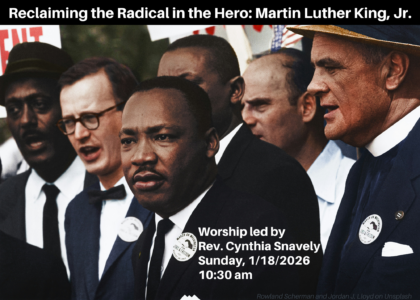
Please click the link to watch Rev. Cynthia Snavely’s video recording of this sermon.
Last Sunday, after the service in which I had compared the racism and militarism of our current time with that of the ‘60s and ‘70s, one of you said, “Yes, but in the 1960s and ‘70s, the racism and violence were coming from the states. Now it is coming from the federal government.”
That is true. There are examples from the’ 60s and ‘70s of the federal government stepping in to force states to integrate the schools or to abide by the federal civil rights legislation. But it is also true that J. Edgar Hoover used the Federal Bureau of Investigation to go after Martin Luther King, Jr., and other civil rights leaders and organizations. They were feared as communists.
Some, such as Bayard Rustin, did have histories with the Communist Party USA. Wikipedia notes, “The Communist Party USA, ideologically committed to fostering a socialist revolution in the United States, played a significant role in defending the civil rights of African Americans during its most influential years of the 1930s and 1940s,” (from Communist Party USA and African Americans – Wikipedia).
Today, New York City Mayor Zohran Mamdani, who declares himself a socialist, is accused of being a communist. A Washington Examiner article by Asher Notheis began, “Rep. Elise Stefanik (R-NY) said … that numerous high-profile Democrats in New York have allowed the ‘Marxist-communist wing’ of the Democratic Party to become ‘mainstream,’” (from Stefanik warns Schumer and Jeffries prop up ‘Marxist-communist wing’ of Democratic Party).
Back in the summer of 2023, an AP news story began, “Donald Trump has announced a new campaign proposal on United States immigration—barring ‘communists’ and ‘Marxists’ from entering the country,” (from Trump wants to keep ‘communists’ and ‘Marxists’ out of the US. Here’s what the law says | AP News).
When we hear “communist,” we usually think of the Soviet Union under Stalin. In May last year, in an opinion piece on NPR, Scott Simon said of Stalin, “He unleashed the Great Terror of the 1930s, in which hundreds of thousands of Soviet citizens were executed in a political purge. He oversaw the deportation of ethnic minorities his government called ‘enemies of the people,’ including Chechens, Ingush, and Crimean Tatars. His policies starved millions of Ukrainians in the Holodomor, the mass famine of 1932 and ‘33. He annexed the Baltic states and parts of several other neighboring countries,” (from Opinion: A new statue for an old tyrant: NPR).
This is not what I want for here.
I do, however, want an economy that has some limits to capitalism. Am I a Marxist, a socialist?
“Jacob Berger is a professor of philosophy at Lycoming College in Williamsport, Pennsylvania. He authored an article in the WSJ on January 23 titled “Why MAGA Folks Should Read Marx,” in which he wrote:
‘[G]iven the history of murderous communist regimes like Stalin’s Russia, Mao’s China and Pol Pot’s Cambodia, it is tempting to infer that Marx encouraged tyranny. But Marx did not advocate violence or political repression, and he would be appalled by the atrocities committed in his name. He pressed for revolution, but he envisioned that the ideal transition from capitalism to communism would be peaceful and democratic, like the Velvet Revolution that freed Czechoslovakia from Soviet rule in 1989,’” (from Yes, Marx Advocated Violence and Political Repression – FEE).
I found that quote in an article by Lawrence Reed of the Foundation for Economic Freedom, a conservative, libertarian think tank, in which he said Berger was wrong and Marx did advocate violent revolution (from Yes, Marx Advocated Violence and Political Repression – FEE).
I don’t know enough about Marx to tell you whether Berger or Reed is right. I do know that my great-grandfather, whom the family says worked to unionize coal mines in eastern Pennsylvania, named my grandfather Ben Marx Hower. My grandfather, if asked what the M in Ben M. Hower stood for, would always say, “Mark.”
When Martin Luther King, Jr. gave the Ware Lecture at our Unitarian Universalist General Assembly—our denominational annual meeting—in 1966, he titled his lecture “Don’t Sleep Through the Revolution.” He referred to the story of Rip Van Winkle sleeping through the American Revolution and then said that “the church”—and it is apparent that he included us in that phrase—must not sleep through the then-current revolution. Unlike with Marx, I can definitively say that King was not calling for a violent revolution.
He said in that Ware lecture, “People talk about the long hot summer that’s ahead. I always say that I don’t think we have to have a long, hot violent summer. I certainly don’t want to see it because I hate violence and I don’t think it solves any problems. I think we can offset the long, hot, violent summer with the long, hot, non-violent summer.
“People are huddled in ghettos, living in the most crowded and depressing conditions. They need some outlet; some way to express their legitimate discontent. What is a better way than to provide non-violent channels through which they can do it? If this isn’t provided, they are going to find it through more irrational, misguided means. So the non-violent movement has a job to do in providing the non-violent channels through which those who are caught in these conditions can express their discontent and frustration.
“Now let me say that I’m still convinced that non-violence is the most potent weapon available to oppressed people in their struggle for freedom and human dignity. And I’d like to say just a word about this philosophy, since it has been the underlying philosophy of our movement. It has power because it has a way of disarming the opponent. It exposes his moral defenses; it weakens his morale. And at the same time it works on his heart and on his conscience, and he just doesn’t know what to do.
“If he doesn’t hit you, wonderful. If he hits you, you develop the quiet courage of accepting blows without retaliating. If he doesn’t put you in jail, that’s very nice, nobody with any sense loves to go to jail. But if he puts you in jail, you go in that jail and transform it from a dungeon of shame into a haven of freedom and human dignity. Even if he tries to kill you, you develop the inner conviction that there are some things so precious, some things so eternally true, that they are worth dying for. If a man has not discovered some thing that he will die for, he isn’t fit to live.
“There’s another good thing about non-violence: Through it, a person can use moral means to procure moral ends. There are still those who sincerely believe that the end justifies the means, no matter what the means happen to be. No matter how violent or how deceptive or anything else they are. Non-violence at its best would break with the system that argues that. Non-violence would say that the morality of the ends is implicit in the means, and that in the long-run of history destructive means cannot bring about constructive ends. So since we are working toward a just society in this movement, we should use just methods to get there,” (from 1966 Ware Lecture: Don’t Sleep Through the Revolution, by Dr. Martin Luther King, Jr. | UUA.org).
But he also said in that lecture (using the word Negro for Black Americans, as was common at the time), “There still are stubborn, difficult problems to deal with all over the country. I’m appalled that some people feel that the civil rights struggle is over because we have a 1964 civil rights bill with ten titles and a voting rights bill. Over and over again people ask, what else do you want? They feel that everything is all right.
“Well, let them look around our big cities. I can mention one where we’re working now, not to say that it’s the worst city in the United States, but just to reveal the problem that we face. Take a city like Chicago; it’s a prototype of all our major urban ghettos. There we find that 90 percent of the Negro children of Chicago are in school with 92 percent children of their own race, which means that the schools are almost 100 percent segregated.
“Facilities are inadequate in all of the ghetto schools. Chicago spends approximately $266 per pupil in the predominantly Negro schools, when $368 are spent in the predominantly white schools. In the suburbs, it spends as much as $780 per pupil. This is a very real problem.
“Then in the area of housing, it is estimated that between 36 and 49 percent of the Negro families of Chicago live in deteriorated housing conditions. Ninety-seven percent of the Negro families of Chicago live in what we refer to sociologically as the ghetto; that is, 97 percent of the Negroes live only with Negroes. They are isolated from the mainstream, the total life of the community.
“In the economic area, the problem is even more serious. Chicago has one of the lowest rates of unemployment of any major city in the United States. It’s 2.6 percent, but when you go to the Negro community, the unemployment rate, which includes only people who once had jobs, is about 10 percent. If you include those who have never held jobs, about 13 percent of the Negro labor force is unemployed.
“If the whole of Chicago confronted in unemployment what the Negro is confronting, there would be a staggering depression, worse than any this country has ever known. So the Negro in his own life is confronting a major depression. This is true of every major city in the United States. While there is great affluence all around, there (is) still stubborn depths of poverty, deprivation and despair.
“The average white high school dropout in Chicago earns more than the average Negro college graduate. Again, this is true in cities all over the country. These are stubborn, difficult problems, and yet they are problems that must be tackled, for I need not remind you of the dangers inherent therein.
“There is nothing more dangerous than to build a society with a large segment of individuals within that society who feel that they have no stake in it, who feel that they have nothing to lose. These are the people who will riot, these are the people who will turn their ears from pleas for non-violence.
“For the health of our nation, these problems must be solved. In the areas of housing, schooling, and employment, there is still a great deal that must be done. We’ve come a long, long way; we still have a long, long way to go, and action programs are necessary.
“I’ve heard it said that the day of demonstrations is over; this is something that we hear a great deal. Well, I’m sorry that I can’t agree with that. I wish that I could say the day of demonstrations is over, but as long as these problems are with us, it will be necessary to demonstrate in order to call attention to them. I’m not saying that a demonstration is going to solve the problem of poverty, the problem of housing, the problems that we face in the schools. It’s going to take something much more than a demonstration, but at least the demonstration calls attention to it; at least the demonstration creates a kind of constructive crisis that causes a community to see the problem and causes a community to begin moving toward the point of acting on it. The church must support this kind of demonstration,” (from 1966 Ware Lecture: Don’t Sleep Through the Revolution, by Dr. Martin Luther King, Jr. | UUA.org).
The Christian minister today whom I see as most fully taking up King’s mantle is the Rev. William Barber, the president and senior lecturer at Repairers of the Breach and co-chair of the Poor People’s Campaign: A National Call for a Moral Revival (William Barber II – Wikipedia). Repairers of the Breach describe themselves as “a national organization that trains moral leaders and builds social justice movements that are rooted in a framework that uplifts our deepest moral and constitutional values.”
They say, “We are committed to supporting moral movements for social change and training fusion leaders, including activists, artists, and people of faith, who organize and mobilize around a moral agenda that lifts from the bottom so that everybody rises.”
King and Barber were and are radical enough to demand economic justice. The Poor People’s Campaign begins their webpage about themselves this way: “In 1968, Rev. Dr. Martin Luther King Jr. and many others called for a ‘revolution of values’ in America. They sought to build a broad, fusion movement that could unite poor and impacted communities across the country. Their name was a direct cry from the underside of history: The Poor People’s Campaign.
“Today, the Poor People’s Campaign: A National Call for Moral Revival has picked up this unfinished work. From Alaska to Arkansas, the Bronx to the border, people are coming together to confront the interlocking evils of systemic racism, poverty, ecological devastation, militarism and the war economy, and the distorted moral narrative of religious nationalism. We understand that as a nation we are at a critical juncture—that we need a movement that will shift the moral narrative, impact policies and elections at every level of government, and build lasting power for poor and impacted people,” (from About – Poor People’s Campaign).
I am not a communist. I do want to work with others for justice for all people; Black, native, immigrant, poor white, everyone. I—we—may not be a Dr. King or a Rev. Barber, but we can be involved in the work.
As I was writing this sermon, I received a late holiday card from a couple in one of my former congregations. The letter included in the card ended by saying, “X still has a limited mental health practice but has focused most of her energies on founding and directing the local Indivisible (county name) United chapter of the national nonpartisan Indivisible Movement. It is an honor to be on Trump’s list of Domestic Terrorists. We had over 1500 folks at last October’s rally she organized… lots and lots of work but well worth the effort to preserve our democracy.
“We close with the quote from German pastor Martin Niemöller, reflecting on his silence during the Nazi persecution. ‘First they came for the Socialists, and I did not speak out—because I was not a Socialist. Then they came for the Trade Unionists, and I did not speak out—because I was not a Trade Unionist. Then the came for the Jews, and I did not speak out—because I was not a Jew. Then they came for me—and there was no one left to speak for me.’
“Please speak out and Make Good Trouble!”
I say, “Embrace your radical. Act nonviolently, but create that good trouble where it is needed.”
If you’ve appreciated this sermon, please visit our Give Now page to support the UUCSH Share the Plate efforts to assist those in need.