
Please click the link to watch Rev. Cynthia Snavely’s video recording of this sermon.
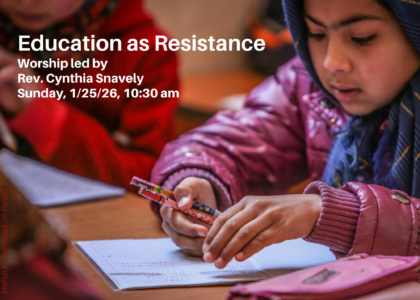
Time for All Ages: Malala’s Magic Pencil by Malala Yousafzai
A couple weeks ago, I said in a service that I was not of an oppressed class. After that service, one of you suggested to me that if a government agent could kill someone of my class and simply walk away saying “f…n’ b…,” I might want to rethink that. I admit I have a lot of protective white privilege. Maybe just not as much as I thought I had.
I expect that as a child of a family of a bit more affluence than the children of the dump, Malala Yousafzai may have thought she had more privilege than she actually had once the Taliban entered her village. On the picture in our Time for All Ages story where she writes, “My voice became so powerful that the dangerous men tried to silence me. But they failed,” she is wearing a hospital gown and wrist band.
As a little girl, she wanted a magic pencil. As she grew and began to speak out and write, she came to know that her voice, her words, were her magic. In a letter at the back of Malala’s Magic Pencil, she writes, “When we are young, we feel powerless. We rely on adults to do the serious work. However, when real danger threatened my right to go to school, I felt stronger than ever, and I found power in my voice. Once, I wished for Sanju’s magic pencil. Now I know that when you find your voice, every pencil can be magic.”
The Wikipedia article on Malala Yousafzai says, “Fluent in Pashto, Urdu and English, Yousafzai was educated mostly by her father, Ziauddin Yousafzai, a poet, school owner, and an educational activist himself, running a chain of private schools known as the Khushal Public School. In an interview, she once said that she aspired to become a doctor, though later her father encouraged her to become a politician instead. Ziauddin referred to his daughter as something entirely special, allowing her to stay up at night and talk about politics after her two brothers had been sent to bed,” (from Malala Yousafzai – Wikipedia).
As I was working on the adult religious education class that I will be offering in the spring on nineteenth-century Unitarian and Universalist women, I was struck by the number who had stories of someone championing their education. Someone saw to it that they had a chance to develop their voice.
Kerri Lee Alexander, in a biography of Frances Ellen Watkins Harper on the National Women’s History Museum page, tells us, “Frances Ellen Watkins Harper was born on September 24, 1825 in Baltimore, Maryland. An only child, Harper was born to free African American parents. Unfortunately, by the time she was three years old, both of her parents [had] died and she became an orphan. Harper’s aunt and uncle, Henrietta and William Watkins, raised her after her parents’ death. Her uncle was an outspoken abolitionist, practiced self-taught medicine, organized a Black literary society, and established his own school in 1820 called the Watkins Academy for Negro Youth. Frances Harper learned from her uncle’s activism, and she attended the Watkins Academy until she was thirteen years old. At that age, children were typically expected to join the workforce. Harper took a job as a nursemaid and seamstress for a white family that owned a bookshop. Her love for books blossomed as she spent any free time she had in the shop,” (from Frances Ellen Watkins Harper | National Women’s History Museum).
When Frances Ellen Watkins Harper and her daughter moved to Philadelphia in 1870, she joined First Unitarian Church there, but she also taught Sunday School at Mount Bethel African American Episcopal Church. And teaching Sunday School in a Black church at that time often meant teaching the children their letters and numbers as well as Bible stories, because many of the children worked during the week and could not attend school on those days.
JoAnn Macdonald writes of Maria Mitchell on the UU Dictionary of Biographies page, “Maria (Ma-RYE-ah) was the third of ten children born to Quakers Lydia Coleman and William Mitchell on Nantucket Island, Massachusetts. William Mitchell, an amateur astronomer, shared with his children what he considered to be the evidence of God in the natural world. Only Maria was interested enough to learn the mathematics of astronomy. At age 12, Maria counted the seconds for her father while they observed a lunar eclipse. At 14, she could adjust a ship’s chronometer, a valuable skill in a whaling port….
“In 1836, Mitchell was hired as librarian at the new Nantucket Atheneum. With the books of the Atheneum at her disposal, Mitchell pursued her studies in languages, mathematics, and navigation. Meanwhile, she and her father made observations of the stars to assist in navigational timekeeping and surveyed the coast of Nantucket. Her discovery of comet Mitchell 1847VI on the night of October 1, 1847, led to international recognition, contacts with the community of American astronomers, and employment doing calculations for the American Ephemeris and Nautical Almanac.
“….Matthew Vassar, who had established Vassar Female College in 1861 as ‘the first U.S. college exclusively for women, based on the principle that women should receive the same education, with the same standards, as that offered in men’s colleges,’ insisted that women in a women’s college should be educated by women instructors. After several years delay due to opposition to women in the faculty within Vassar’s board of trustees, Mitchell was appointed Professor of Astronomy. She taught there from 1865 to 1888.”
“…Mitchell encouraged her students to think of themselves as professional women. She asked, “How many pulpits are open to women?” And “Do you know of any case in which a boys’ college has offered a Professorship to a woman? Until you do, it is absurd to say that the highest learning is within the reach of American women.”
“’For women, there are undoubtedly great difficulties in the path, but so much the more to overcome,” Mitchell told her students. “‘First, no woman should say, ‘I am but a woman.’ But a woman! What more can you ask to be? Born a woman, born with the average brain of humanity, born with more than the average heart, if you are mortal, what higher destiny could you have? No matter where you are nor what you are, you are a power. Your influence is incalculable,” (from Mitchell, Maria – Dictionary of Unitarian & Universalist Biography).
Joan Goodwin wrote the biography of Louisa May Alcott on the Dictionary of Unitarian and Universalist Biography web page. As you might expect, Louisa was taught by her father, the educator Bronson Alcott.
Goodwin writes, “The girls were mostly educated at home. ‘I never went to school,’ Louisa wrote, ‘except to my father or such governesses as from time to time came into the family … so we had lessons each morning in the study. And very happy hours they were to us, for my father taught in the wise way which unfolds what lies in the child’s nature as a flower blooms, rather than crammed it, like a Strasburg goose, with more than it could digest. I never liked arithmetic nor grammar … but reading, writing, composition, history, and geography I enjoyed, as well as the stories read to us with a skill peculiarly his own.’
“…With the outbreak of the Civil War, Alcott was eager to do her part. She had long attended antislavery meetings and fairs. ‘I became an Abolitionist at an early age,’ she wrote, ‘but have never been able to decide whether I was made so by seeing the portrait of George Thompson [the British abolitionist] hidden under a bed in our house during the Garrison riot … or because I was saved from drowning in the Frog Pond some years later by a colored boy. However that may be, the conversion was genuine; and my greatest pride is in the fact that I lived to know the brave men and women who did so much for the cause, and that I had a very small share in the war which put an end to a great wrong.’
“Alcott’s ‘small share’ was a month’s service during the winter of 1862–63 as a nurse at the Union Hotel Hospital in Georgetown, Virginia. Though she began with characteristic determination, typhoid pneumonia soon forced her home. Her health was permanently damaged by the fever and by the calomel (mercurous chloride) with which she was dosed. After a gradual recovery she was able to write ‘Hospital Sketches,’ serialized in the Boston Commonwealth and published in book form in August 1863. The book was extremely popular and stimulated calls for more of her work. In December she published two more books, and her dramatization of ‘Scenes from Dickens’ opened in Boston as a benefit for the Sanitary Commission,” (from Alcott, Louisa May – Dictionary of Unitarian & Universalist Biography).
Caroline Wells Healy Dall, an author, journalist, lecturer and champion of women’s rights, a Unitarian community service worker, minister’s wife, and lay preacher, has a bio by Spencer Lavan and Peter Hughes on the UU Dictionary of Biography site.
They write, “Caroline was the oldest of 8 children born in Boston to Unitarians Caroline Foster and Mark Healey (1791–1876), a successful India merchant, banker, and later, investor in railroads. Her father taught 18-month-old Caroline to pick out letters from the large type on the front page of the Christian Register. In a time when most did not take girls’ education seriously, he engaged tutors for her and sent her to private schools.
“Between ages 13 and 15 she studied Latin and modern languages, notably French and Italian…. When Caroline was 12, she attended a series of lectures given by Ralph Waldo Emerson. Criticized for having given so expensive a ticket to a child, her father said, ‘I shall expect her to write abstracts of them.’ He directed her to concentrate as she listened, and without notes, to write what she remembered the next day. … In 1865 Caroline Dall helped to found the American Social Science Association, an organization for helping the poor, unemployed, imprisoned, and mentally ill, and served on its executive committee for forty years.” (from Dall, Caroline – Dictionary of Unitarian & Universalist Biography).
Olympia Brown “was ordained a Universalist minister, the first woman to achieve full ministerial standing recognized by a denomination.”
Of her education, Laurie Carter Noble writes on the UU Dictionary of Biography site of Olympia Brown, “The first of four children, Olympia Brown was born to Vermont Universalists Asa B. and Lephia Olympia Brown, pioneers in Prairie Ronde, Michigan. Determined to give his children a good education, her father built a schoolhouse on his farm. He and Olympia rode from house to house to enlist their neighbors’ donations toward hiring a teacher. The Brown children later attended school in the nearby town of Schoolcraft.
“Olympia was determined to go to college and persuaded her father to allow her and a younger sister to enter Mary Lyons’s Mount Holyoke Female Seminary in Massachusetts. After an unhappy year in the rigidly Calvinistic atmosphere there, Olympia went to Antioch College in Yellow Springs, Ohio, where Horace Mann was president. Her experience there was so positive that her family moved to Yellow Springs for all four children to get a good education….
“(Olympia) Brown joined in many of the demonstrations organized by the Woman’s Party. In freezing rain, in bitter cold, in spite of dangerous confrontations and little police protection from hecklers, the octogenarian minister from Wisconsin was there. During one memorable demonstration, protesting Woodrow Wilson’s turning his back on the suffrage amendment, she publicly burned his speeches in front of the White House. When the suffrage amendment was finally passed in 1919, Brown was one of the few original suffragists who was still alive to savor the triumph. She voted in her first presidential election at the age of 85.
“Speaking in the Racine church in the fall of 1920 on the changes that had taken place since her resignation as minister, she said, ‘the grandest thing has been the lifting up of the gates and the opening of the doors to the women of America, giving liberty to twenty-seven million women, thus opening to them a new and larger life and a higher ideal,” (from Brown, Olympia – Dictionary of Unitarian & Universalist Biography).
The nineteenth-century Unitarian and Universalist women were mostly white and mostly middle-class. They were what today is being called by the acronym AWFUL: affluent, white, female, urban, liberal. Though they had to fight for their rights, they did have more privilege than African Americans.
Like women, African Americans knew the value of education, which for so long had been denied to them. Willard C. Frank, Jr. on the UU Dictionary of Biography, writes, “Joseph Jordan (1842-1901), the first African American to be ordained as a minister by the Universalist denomination, founded the First Universalist Church of Norfolk, Virginia in 1887 and initiated an educational effort for African American children in Norfolk and vicinity. The missions and schools that were his legacy served thousands of children and families in eastern Virginia over the period of a century,” (from Jordan, Joseph – Dictionary of Unitarian & Universalist Biography).
Many of us may already know the story Frederick Douglass—who was not a Unitarian or Universalist—told of his education.
From the Wikipedia article on Douglass: “In 1826, Douglass was given to Lucretia Auld, wife of Thomas Auld, who sent him to serve Thomas’s brother Hugh Auld and his wife Sophia Auld in Baltimore… When Douglass was about 12, Sophia Auld began teaching him the alphabet. Hugh Auld disapproved of the tutoring, feeling that literacy would encourage enslaved people to desire freedom. Douglass later referred to this as the “first decidedly antislavery lecture” he had ever heard. ‘Very well, thought I,’ wrote Douglass. ‘Knowledge unfits a child to be a slave. I instinctively assented to the proposition, and from that moment I understood the direct pathway from slavery to freedom.’
“Under her husband’s influence, Sophia came to believe that education and slavery were incompatible, and one day snatched a newspaper away from Douglass. She stopped teaching him altogether and hid all potential reading materials, including her Bible, from him. In his autobiography, Douglass related how he learned to read from white children in the neighborhood and by observing the writings of the men with whom he worked.
“Douglass continued, secretly, to teach himself to read and write. He later often said, ‘Knowledge is the pathway from slavery to freedom,’” (from Frederick Douglass – Wikipedia).
Unfortunately, education has been used not just to liberate, but also to control. American Indian children were often forcibly taken to American Indian Boarding Schools, where they were forced to give up their own language and religion in an attempt to assimilate them into white culture. Wikipedia has a list of links under the topic “reeducation camps.”
“The Xinjiang internment camps are internment camps operated by the government of Xinjiang and the Chinese Communist Party Provincial Standing Committee. Human Rights Watch says that they have been used to indoctrinate Uyghurs and other Muslims since 2017 as part of a ‘people’s war on terror’, a policy announced in 2014,” (from Xinjiang internment camps – Wikipedia).
“Re-education camps (Vietnamese: Trại cải tạo) were prison camps operated by the communist Việt Cộng and Socialist Republic of Vietnam following the end of the Vietnam War. In these camps, the government imprisoned at least 200,000–300,000 former military officers, government workers and supporters of the former government of South Vietnam. …’Re-education’ as it was implemented in Vietnam was seen as both a means of revenge and as a sophisticated technique of repression and indoctrination,” (from Re-education camp (Vietnam) – Wikipedia).
During the Cultural Revolution in China, “Many people were sent to the countryside to work in reeducation camps,” (from https://en.wikipedia.org/wiki/Cultural_Revolution).
Unfortunately, I am sure I could go on. It is, though, often one’s previous education that enables one to survive in such places. Though oppressors may try to equate education with indoctrination, they are not the same thing. Indoctrination imprisons. Education liberates. Indoctrination attempts to control. Education enables resistance.
In our own country, books may be banned and historical plaques changed, but many of us are going to keep telling the stories that others seek to repress. Educating ourselves and educating others is part of the resistance. Frederick Douglass knew that “knowledge is the pathway from slavery to freedom.” Today I know that knowledge is our best defense of our freedoms.
As Edward Everett, a nineteenth-century American politician, Unitarian pastor, educator, diplomat, and orator, said, “Education is a better safeguard of liberty than a standing army.”
If you’ve appreciated this sermon, please visit our Give Now page to support the UUCSH Share the Plate efforts to assist those in need.