
Please click the link to watch Rev. Cynthia Snavely’s video recording of this sermon.
If you have been a Unitarian Universalist for a long time, you may know the drill. Someone newer to Unitarian Universalism says UUs can believe anything they want. Then you step in. Yes, Unitarian Universalists can believe there is a God or there is a Goddess, or there is no God, or there are many gods; or they can remain agnostic on the question of God. All those are possibilities for the Unitarian Universalist.
Yes, Unitarian Universalists can believe that after we die we go to heaven or that after we die we are reincarnated, or that after we die we become a spiritual ancestor able to help those still here on Earth, or that nothing happens after death; or we can remain agnostic on the question of what—if anything—lies beyond death. All those beliefs are possible for a Unitarian Universalist. But it is not true that we can believe anything we want. We have some shared values.
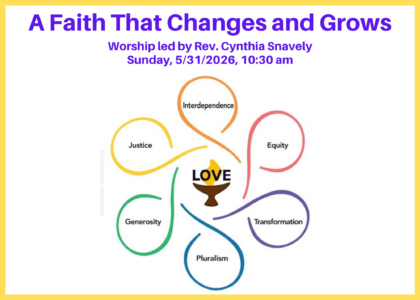
A Unitarian Universalist cannot believe white people are inherently better than people of color. That belief goes against our shared value of equity. To quote Article Two of the Bylaws of our Association, “Inseparable from one another, these shared values are [and then the sixth one listed is]: Equity. We declare that every person is inherently worthy and has the right to flourish with dignity, love, and compassion.”
Someone can be a Unitarian Universalist Christian or a Unitarian Universalist Muslim. The one thing a UU Christian or UU Muslim can’t believe is that people who are not Christian or not Muslim are damned to hell. That goes against our value of pluralism: “Pluralism. We celebrate that we are all sacred beings, diverse in culture, experience, and theology. We covenant to learn from one another in our free and responsible search for truth and meaning. We embrace our differences and commonalities with Love, curiosity, and respect.”
Indeed, of religious concepts, the one I think it would be most difficult for a Unitarian Universalist to hold is a belief in a hell beyond the hells we create for ourselves by our actions here on Earth. Can we believe even a Hitler or a Pol Pot should be tortured for eternity?
We say, “Love is the power that holds us together and is at the center of our shared values. We are accountable to one another for doing the work of living our shared values through the spiritual discipline of Love.” Does not the whole concept of hell go against the value of love?
No, Unitarian Universalists cannot believe anything we want. But Unitarian Universalism is open to a wide variety of thought. As I said in my blurb for today’s sermon, “When I moved from United Methodism to Unitarian Universalism, I realized that even if my spiritual ideas changed again, I would not need to again change my denomination. Unitarian Universalism offered me the possibility to question, change, and grow in my spirituality and remain in this community of faith.”
In my collection of readings gathered over the years, one of my favorites is from a UU minister colleague, now gone, who grew up in what was for her then—before the merger or our two parent denominations—Unitarianism. And, yes, I know I have shared it with you before. Here it is again.
Jane Rzepka wrote,
“I grew up in one of those Unitarian fellowships in the Midwest. And that little religious community really left its mark on me.
“For one thing, the grown-ups there believed we ought to use our heads. They encouraged us to ponder the big questions of beginnings and endings and anger and love and what was before and what comes next and what helps and what hinders. They thought we were smart kids, they listened to our ideas, we believed we were good thinkers. Now of course I know that the use of reason is a cornerstone of our long religious heritage, but then I just thought it was the way we did things at the Unitarian Church.
“And then in another mode we planted daffodils, we looked at the stars, we searched for guppies, we held a worship service at the river. These days we call it spirituality I suppose or Earth-centered religion, but then we called it ‘miracle’ and ‘wonder.’ And that rootedness is in my blood as a Unitarian.
“Finally, back then, we children knew that we were a part of congregation that loved us. They taught us Sunday School. They doled out the cookies at coffee hour. They chaperoned the Youth Group. They wanted to know what we would do after graduation. They wrung their hands; they clapped their hands—for us, for one another. Now we call it community; now we call it connection. But, for me, back then, it was just Unitarianism.”
Yes, we can change and grow within this faith, but it also offers us a grounding. There are people around us who will make us defend our beliefs. We have to think them out and understand for ourselves why we believe what we believe. There are people around us who are ready and willing to share our wonder and awe at the beauty of this world. There are people around us who will challenge us to write that letter, make that phone call, attend that rally, run for that office, speak up at work against some injustice. There are people around us who will cry with us when despite time, money and effort, we can’t get pregnant or we lose the job we loved, or our best friend dies.
I have said more than once that if I had to pick one holy word for my own beliefs, my own theology, it would be connection.
One of my favorite spiritual teachers is the Vietnamese Zen Buddhist monk Thich Nhat Hanh, who died in 2022. In his 1995 book Living Buddha, Living Christ, he wrote,
“The Buddhist term is vipasyana (insight, or looking deeply). ‘Looking deeply’ means observing something or someone with so much concentration that the distinction between observer and observed disappears…. When we look into the heart of a flower, we see clouds, sunshine, minerals, time, the earth, and everything else in the cosmos in it. Without clouds there could be no rain, and there would be no flower. Without time, the flower could not bloom. In fact, the flower is made entirely of non-flower elements; it has no independent, individual existence. It ‘inter-is’ with everything else in the universe. Interbeing is a new term, but I believe it will be in the dictionary soon because it is such an important word. When we see the nature of interbeing, barriers between ourselves and others are dissolved, and peace, love, and understanding are possible.’”
I still use the word “God,” because that is the word most people in this culture use to describe the holy or the sacred, but when I use the word “God” I mean something more like the Tao, something that connects all things, rather than “God” as a person and creator of everything.
Chapter 34 of the Tao Te Ching states, “The great Tao flows everywhere, both to the left and to the right. The ten thousand things depend upon it; it holds nothing back. It fulfills its purpose silently and makes no claim. It nourishes the ten thousand things, and yet is not their lord. It has no aim; it is very small. The ten thousand things return to it, yet it is not their lord. It is very great. It does not show greatness, and is therefore truly great.”
I think these beliefs of mine fit well with the Unitarian Universalist central value of love.
I am a Unitarian Universalist who prays. “Wait a minute,” you may say, “you just said you didn’t believe in God as a person.” That is true, but remember, I also said “connection” is my holy word. When I pray, I think of my thoughts and feelings spreading out over the great interconnected web of all existence. And I think of prayer not just as my sharing, but as also taking the time to listen for what others are sharing.
I like the story that nineteenth-century Unitarian minister Theodore Parker apparently told many times about an event from his childhood. Unitarian Universalist Gary Kowalski tells it this way:
“In his autobiography, Theodore Parker relates that as a child, four or five years old, living on a farm in Roxbury, he was walking through the fields one day absent-mindedly swinging a stick through the tall grass. This was many years ago, in the days before the Civil War. It was summertime. He stopped to watch the water bubble along a creek. Then he noticed a turtle sunning itself on a rock.
“He’d seen other boys use their sticks to strike at turtles and other animals. It was part of what children thought was fun, just as some children still like to bully and hit those who are weaker than themselves. Often children and grown-ups too are copycats—mimicking the behavior of others who seem bigger or stronger than themselves. Young Theodore wanted to be like the other, older boys he’d seen, so he raised his stick into the air, taking aim and preparing to knock the turtle into the water.
“Then something stopped him. Something seemed wrong about the situation. He looked again at the turtle, quiet, peaceful, enjoying the summer day just as he liked to feel the warmth and light of the sun. Had the turtle ever done him any harm? Was the turtle so different than himself? Slowly he lowered his stick and walked home, thinking about what had happened.
“When he arrived home, his mother was there to greet him, and he told her about the incident. She listened carefully to Theodore, and listened especially carefully when he related how some strange force inside had stopped him from hitting the little animal.
“‘Theodore,’ she said, ‘that force inside you was the voice of conscience. Always pay attention to it. Always follow what your conscience tells you. It’s your moral compass that points you in the right direction. And if you honor your conscience, you’ll never go wrong in this world.’
“Theodore Parker grew up to become a Unitarian minister, in fact one of the greatest leaders our faith has ever known. He became a champion of the defenseless who needed defending. He was a hero in the fight to end slavery in our country. He prayed to ‘Father and Mother God’ and fought for women’s equality and their right to vote. He and his wife never had children of their own, but he felt a sense of kinship with the whole family of creation, people of all sexes and races who had been made in the image of the holy. And it all started one summer day when he was just a child—a child who saw a turtle and decided to do what was right.”
Connection: I think of what Parker felt as the listening kind of prayer.
I turn to Thich Nhat Hanh again for another example of prayer to which I relate. Again, from his book Living Buddha, Living Christ:
“During a conference on religion and peace, a Protestant minister came up to me toward the end of one of our meals together and said, ‘Are you a grateful person?’ I was surprised. I was eating slowly, and I thought to myself, Yes. I am a grateful person. The minister continued, ‘If you are really grateful, how can you not believe in God? God has created everything we enjoy, including the food we eat. Since you do not believe in God, you are not grateful for anything.’ I thought to myself, I feel extremely grateful for everything. Every time I touch food, whenever I see a flower, when I breathe fresh air, I always feel grateful. Why would he say I am not? I had this incident in mind many years later when I proposed to friends at Plum Village that we celebrate a Buddhist Thanksgiving Day every year. On that day, we practice real gratitude—thanking our mothers, fathers, ancestors, friends, and all beings for everything. If you meet that Protestant minister, I hope you will tell him that we are not ungrateful. We feel deeply grateful for everyone and everything.”
I have been telling you something of what I believe and why. That is part of our Unitarian Universalist tradition. We think about what we believe. Next Sunday, some of our young people will tell you about what they currently believe as they complete their Coming of Age class by sharing their credo statements with us in our worship service.
I end with a reading from Unitarian Universalist religious educator Sophia Lyon Fahs. In the back of our hymnal, this reading is titled “It Matters What You Believe.”
“Some beliefs are like walled gardens. They encourage exclusiveness, and the feeling of being especially privileged. Other beliefs are expansive and lead the way into wider and deeper sympathies. Some beliefs are like shadows clouding children’s days with fears of unknown calamities. Other beliefs are like sunshine, blessing children with the warmth of happiness. Some beliefs are divisive, separating the saved from the unsaved, friends from enemies. Other beliefs are bonds in a world community, where sincere differences beautify the pattern. Some beliefs are like blinders, shutting off the power to choose one’s own direction. Other beliefs are like gateways opening wide vistas for exploration. Some beliefs weaken a person’s selfhood. They blight the growth of resourcefulness. Other beliefs nurture self-confidence and enrich the feeling of personal worth. Some beliefs are rigid, like the body of death, impotent in a changing world. Other beliefs are pliable, like the young sapling, ever growing with the upward thrust of Life.”
Ronald J. Glossop said,
“Sophia Lyon Fahs has noted [that] beliefs are important in our lives. The kinds of beliefs we have influence how we behave. Knowing what is true is important. But having true beliefs is not the most important thing in our lives, and having true beliefs about God is not the most important thing in religion. The most important thing in religion is being committed to furthering goodness. Promoting goodness includes finding out what is true and helping others to acquire such knowledge, but it also includes furthering love and compassion and justice. And it involves doing this whether or not there is a God helping us to accomplish it.”
We are Unitarian Universalists. We cannot believe anything we want. We do not believe because we are told to believe. As Rzepka put it, we “ponder the big questions of beginnings and endings and anger and love and what was before and what comes next and what helps and what hinders.” Then we decide for ourselves. Sometimes those chosen beliefs remain with us until the end of our lives. Other times we ponder again and change our thoughts. That is who we are as Unitarian Universalists.
If you’ve appreciated this sermon, please visit our Give Now page to support the UUCSH Share the Plate efforts to assist those in need.