
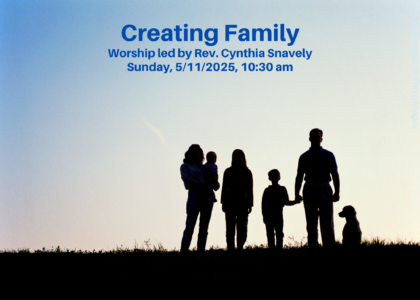
Please click the link to watch Rev. Cynthia Snavely’s video recording of this sermon.
I turned 40 and was unmarried and had no children. It was not the number itself that struck me as much as the fact that my grandmother was 40 when I was born. I had reached my grandmother’s age childless. I did not have the funds or the time to adopt and begin to raise an infant. I began the process of adopting a school-age child through the local foster care agency. I had to fill out a form. Would I take on a child of any gender, of any race? What possible physical disabilities could I handle and what could I not? What ages would I consider?
I said any gender, any race. I could handle blindness or deafness, but a disability that meant I would need to lift and move the child for the rest of their life, I didn’t think I could do. Intellectual disability, probably not. While I wanted to raise a child, I also wanted to eventually be done with child-raising. Ages 6–10. Of course, I know that people birthing children don’t get to make many of those choices.
The social worker pressed a bit on the age range. How about a 12-year-old? Okay. Also, this child has two sisters. They have been with a foster family with eight children. The social workers wanted to put the sisters in separate homes to give them more one-on-one attention, but they wanted them to be homes that would maintain the connection between them. Okay. Oh, and in Maryland a child over the age of 11 gets to choose for themselves whether or not they want to be adopted. Okay. One African American 12-year-old girl was brought to my home on Mother’s Day. I had prepared a special meal. She didn’t eat it. She went to her new room and cried.
Becoming a family was not so easy. My daughter hated going to Pennsylvania to see my family. She did not feel accepted, and years later I realized that by some, she was not. I would take my daughter to her grandfather’s house for her family’s holiday meals. I was invited to stay, but I never really felt accepted into her family either. Both my daughter and I lost some of the fullness of our connections with our birth families as we became family together.
Sometimes people would make comments about what a noble thing I was doing raising this child putting me in “white savior” mode, which I hated. I just wanted a child to raise, not to “save.”
Sometimes my daughter’s sisters would tell her to stop talking “white.”
My daughter wanted her ears pierced. The lady behind the counter at the mall refused us. She said my daughter’s mother needed to sign.
From the trivial to the significant, becoming family was not easy.
Neither of my daughter’s sisters were in pre-adoptive homes. Out of loyalty to them and for other reasons as well, for many years my daughter chose not to be adopted. She was 17 before we went to court to make our family legally official. By then it seemed anti-climactic.
Among Unitarian Universalists, a wide diversity of families seems normal, but each iteration of family must face its own unique challenges.
Yes, today is Mother’s Day, but not all families include a mother. Recently, UU minister Rev. Manish Mishra-Marzetti shared this in a Braver/Wiser email.
“Spring Break. I’m with my family in Orlando and my child needs to go to urgent care. As an Asian-American in a gay marriage, with adopted kids who are Black, I had booked this Florida vacation in the good old days of our former President. Everything is different now.
“I arm my white, cis male husband, Jeff, with our travel file—the folder with copies of our marriage certificate, the court orders declaring my husband and me the legal parents of our children, and more—and make an appointment for him at the closest urgent care. (This is often our family’s safety plan: the white guy in the family takes the lead.)
“As Jeff and our child register at AdventCare, the receptionist inquires what Jeff’s relationship to our child is. He explains. When meeting with the doctor, Jeff offers, with carefully chosen language, that his ‘spouse’ had a bronchial infection, and now our kiddo does too.
“’How long was your wife sick? What was she prescribed?’ Jeff takes a risk and responds, “He had bronchitis.” Only after receiving the needed prescriptions do we figure out that AdventCare is run by a denomination that is vociferously anti-gay. My heart sinks; I wonder if we got lucky.
“The same week, on our family’s day at Epcot, I wear my ‘Mickey Pride’ shirt—the only Disney shirt I own: Mickey, Minnie, and a colorful explosion of rainbows and hearts.
“Within half an hour of arriving, a thirteen-year-old boy goes out of his way to tell me how much he loves my shirt—beaming from ear-to-ear, knowingly—as his mom coaxes him back to their family. Another family spends half an hour getting to know our kids, gifting them trading cards, and offering us more ear-to-ear grins of love and affirmation. Near the end of our Epcot day, a park employee comments that she ‘likes my shirt’ (by now I realize that I’m a walking billboard of gayness) and asks how our day in the park has been going.
“I think about the fear I was feeling in contrast to this day: So much love and support, from so many unexpected directions. And I’m grateful.”
No matter what iteration our family comes in, it needs to be continuously created and recreated. We don’t know when our family is formed where the pitfalls may be or where outside support may come from.
I put down on my foster-adoptive family form that I was open to a child of any race. I was required to take classes on both parenting and parenting in a multicultural home, but I didn’t know what I was getting into. My daughter was embarrassed that I didn’t look like her. She understood that she was not accepted by all my family, even though I was blind to it.
I remember years ago being at an anti-racism training. The group was to be put into a white affinity group and a people of color affinity group. Some white participants with spouses and/or children who were people of color insisted on a third group for them and asked me to join them. At the time, I—a bit reluctantly—did, but I realize now that having a spouse or a child who is a person of color does not unblind us from our white privilege. We would have been fine and perhaps learned more in the white affinity group.
For many years now I have dated a Black man. Once we were going to a wedding reception in rural Maryland. I was driving. We got lost. I blithely pulled into a driveway where a man was standing and smoking and asked for directions. It was only afterward that I realized my companion thought that my actions could have gotten us killed. Once at a frozen yogurt shop in Virginia he pointed out that someone at a nearby table was staring at us. I hadn’t noticed. I have not needed to be attuned to the racism in society, and so I have needed to be taught in my adulthood how to see it. My daughter and my gentleman friend teach me, but it shouldn’t be their job to do so.
To celebrate the diversity in our families while we are constantly creating and recreating them means listening when your child says they are transgender, hearing your spouse when they say they need to change jobs, listening to yourself when something isn’t feeling right, and working to put it into words.
As I was asked to say what kind of child I felt I could parent, so too was my daughter asked what type of home she thought she would like to have. She had said she wanted pets. At the time I had a cat and a dog. Her first evening with me the cat nipped her, and the dog scared her when he started barking as she got up to use the bathroom.
One day we met one of her aunts as we were at the playground at the school near our house. Her aunt asked her about her new home. She said she had a cat, Cookie, and a one-eyed dog named Ewok. Her aunt asked more about Ewok. It turned out another aunt had had two dogs, Ewok and Peewee, who had run out into the road. Peewee was killed, and Ewok had lost an eye. Eventually, the other aunt needed to give up Ewok. I had adopted my Ewok from the county shelter. Apparently, I already had a connection to my daughter’s birth family before she came to me.
The member of her birth family with whom my daughter was closest was her grandfather, her pop-pop. He couldn’t raise her or her sisters, but he never lost touch with them. He would take them to a playground near the Baltimore airport, where they could watch the planes fly in and fly out. My daughter kept a shiny pink raincoat long after she could fit into it, because it was a gift from her pop-pop.
He is gone now, but each of the girls has some memento of him which they still cherish.
Just who is our family? My daughter’s sisters call me aunt, and I call them nieces, though we have no legal or blood relationship. A young woman I mentored years ago, who still keeps in touch, calls me Ma. Who is family?
UU minister Patrick O’Neill wrote this: “Among the most accomplished and fabled tribes of Africa, no tribe was considered to have warriors more fearsome or more intelligent than the mighty Masai. It is perhaps surprising, then, to learn the traditional greeting that passed between Masai warriors: ‘Kasserian Ingera,’ one would always say to another. It means, ‘And how are the children?’
“It is still the traditional greeting among the Masai, acknowledging the high value that the Masai always place on their children’s well-being. Even warriors with no children of their own would always give the traditional answer: ‘All the children are well,’ meaning, of course, that peace and safety prevail, that the priorities of protecting the young, the powerless, are in place. That Masai society has not forgotten its reason for being, its proper functions and responsibilities. ‘All the children are well’ means that life is good. It means that the daily struggles for existence do not preclude proper caring for their young.”
O’Neill continues with some imaginings, and Imagination is our theme this month. He says, “I wonder how it might affect our consciousness of our own children’s welfare if in our culture we took to greeting each other with this daily question: ‘And how are the children?’ I wonder if we heard that question and passed it along to each other a dozen times a day, if it would begin to make a difference in the reality of how children are thought of or cared about in our own country.
“I wonder if every adult among us, parent and non-parent alike, felt an equal weight for the daily care and protection of all the children in our community, in our town, in our state, in our country… I wonder if we could truly say without any hesitation, ‘The children are well, yes, all the children are well.’
“What would it be like… if the minister began every worship service by answering the question, ‘And how are the children?’ If every town leader had to answer the question at the beginning of every meeting: ‘And how are the children? Are they all well?’ Wouldn’t it be interesting to hear their answers? What would it be like? I wonder….”
How are the children of Gaza? How are the children of Sudan? How are the children of Afghanistan, especially the girls? How are the children in our American foster care system today? This coming Saturday is the International Day Against Homophobia, Transphobia and Biphobia. How are our children who identify as gay, trans or bi?
One of our core Unitarian Universalist values is justice. We say, “We work to be diverse multicultural Beloved Communities where all thrive.” What do we need to do before we can answer the question, “How are the children? with “The children are well, yes, all the children are well?”
Happy Mother’s Day!
If you’ve appreciated this sermon, please text to give or visit our Give Now page to support the UUCSH Share the Plate efforts to assist those in need.