
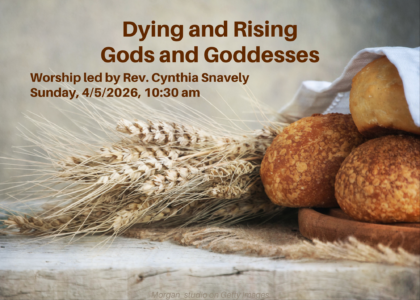
Please click the link to watch Rev. Cynthia Snavely’s video recording of this sermon.
Do you know the Egyptian story of Osiris, killed by his brother Seth? His wife Isis rescues his body, but Seth reclaims the body and Osiris’s body parts are planted in the soil across Egypt. But Osiris is not defeated. He rises up in a new form like seed planted in the ground which grows into new plants.
In Greece, Persephone, daughter of Demeter, the goddess of the grain and harvest, is carried off into the underworld. After her mother rescues her, she must return to the underworld for a part of every year, because while there she has eaten pomegranate seeds.
Osiris and Persephone are rescued or reclaimed by one who loves them: for Osiris, his wife; for Persephone, her mother. Osiris becomes judge of the dead, weighing their hearts. Adherents of the Eleusinian Mysteries believed their devotion to Persephone and Demeter would grant them life after death. These grain gods and goddesses became associated with the dead. Seed buried in the earth grows into new life. It is understandable that people hoped that the same might happen for their dead.
But how does Jesus, a Jewish rabbi, end up in this pantheon of grain gods and goddesses, of these dying and rising gods?
I have an idea. What was one of the most significant aspects of Jesus’s ministry? His sitting down to eat with people that in general no other Jewish religious teacher would eat with, people who had sold themselves out to the oppressor collecting taxes for Rome, people who sold themselves as prostitutes. One of the most significant parts of his ministry was these meals. He was willing to companion those whom others rejected. The root words of companion are “with” (com) and “bread” (pan). A companion is someone with whom one eats. Jesus cared about people whom others dismissed. He sat down and ate with them.
bell hooks, in her book All About Love, writes, “Pressed in therapy to describe my household of origin in terms of whether it was loving or not, I painfully admitted that I did not feel loved in our household but that I did feel cared for. And outside my household of origin I felt genuinely loved by individual family members, like my grandfather. This experience of genuine love (a combination of care, commitment, trust, knowledge, responsibility, and respect) nurtured my wounded spirit and enabled me to survive acts of lovelessness,” (hooks, bell. All About Love (Love Song to the Nation), pp. 38-39. HarperCollins. Kindle Edition).
The New Testament scholar Norman Perrin says, “The central feature of the message of Jesus is, then, the challenge of the forgiveness of sins and the offer of the possibility of a new kind of relationship with God and with one’s fellow (person). This was symbolized by a table fellowship which celebrated the present joy and anticipated the future consummation; a table-fellowship of such gladness that it survived the crucifixion and provided the focal point for the community life of the early Christians and was the most direct link between the community and the pre-Easter fellowship of Jesus and his disciples.”
If you will, this was a meal that offered people who had not had it before genuine love, (a combination of care, commitment, trust, knowledge, responsibility, and respect) that could nurture the wounded spirit and enable one to survive acts of lovelessness.
But what happens when the provider of such longed-for, such needed love is brutally executed by the state? Apparently, what happens is that those who have experienced such love find that it is still there. They actually keep seeing Jesus amongst them.
The earliest stories of Jesus’s resurrection are not stories of an empty tomb and a physical raising up of his body but of his followers experiencing his presence after his death. In Paul’s First Letter to the Corinthians he writes, “…he appeared to Cephas, and then to the Twelve. After that, he appeared to more than five hundred of the brothers and sisters at the same time, most of whom are still living, though some have fallen asleep. Then he appeared to James, then to all the apostles, and last of all he appeared to me also, as to one abnormally born,” (I Corinthians 15:3-8NIV), abnormally born because the appearance to Paul came so much later in time than the other appearances and to one who was not one of the original disciples of Jesus.
From stories in the gospels, we learn that in some of these appearances Jesus was recognized when he broke and blessed bread or was recognized and then broke bread.
From Luke chapter 24: “As they approached the village to which they were going, Jesus continued on as if he were going farther. But they urged him strongly, ‘Stay with us, for it is nearly evening; the day is almost over.’ So he went in to stay with them. When he was at the table with them, he took bread, gave thanks, broke it and began to give it to them. Then their eyes were opened, and they recognized him….” (Luke 24: 28-30a NIV).
From John chapter 21: “Jesus said to them, ‘Come and have breakfast.’ None of the disciples dared ask him, ‘Who are you?’ They knew it was the Lord. Jesus came, took the bread and gave it to them, and did the same with the fish,” (John 12-13, NIV).
The early Christians believed Jesus was still with them even after his death. Some of them even said they saw him with them in a room, with them on the road, with them on a beach. Sometimes they knew it was him or it was confirmed to them that it was him when he took the role of host at a meal and gave them food.
I can see how once Paul began preaching the Christian message to the Gentiles, the stories of Jesus began to be conflated with the stories of the grain gods, the dying and rising gods that the Gentiles knew from common traditions. Love is an important part of those stories. Isis’s love is what brings her husband Osiris back to his living worshippers. Demeter’s love is what brings her daughter Persephone back.
And a gift of bread is a sign of loving care. Twentieth-century Indian lawyer, anti-colonial nationalist and political ethicist Mahatma Gandhi said, “There are people in the world so hungry, that God cannot appear to them except in the form of bread.” Whether one is physically hungry for food or hungry for love or both, sharing food with someone who offers you care, commitment, trust, knowledge, responsibility, and respect can staunch that hunger.
Back in 1975, the Congregation of Abraxas movement arose in Unitarian Universalism. Abraxas is a Gnostic name for god. Members of the movement expressed a desire for more ritual and over time created a number of ritual services. These words are from an Abraxas Eucharist: “The mystery is that we are connected even when we feel apart: Let us make word and deed one now, as we remember the ancient words… if you bring your gifts to the altar and there remember that your neighbor has something against you, leave your gifts there before the altar, and go your way. First be reconciled with your neighbor, and then come and offer your gift…. We look to the future, a future to be made; a church whose creed is truth, whose worship is love, a society full of industry, wisdom, and the poetry of life; a state with unity among all with freedom for each; a church without tyranny, a society without want, a state without oppression, a world without war. Shall this ever be fact? History says, No! Human nature says, Yes!…. We gather at this table to celebrate our community, and our communion with sacred sun and soil, and the spirit which sustains us all. We partake of this food and drink as a sign of our covenant with all humanity, as an expression of our sacred concern for one another, as a symbol of our commitment to live in peace with all beings…. We are invited to feed one another as a model for feeding the world…. As you share the bread, say to your neighbor: We are all one body. As you share the wine, say to your neighbor: We are all blood kin.”
As I was thinking about bread and love, I thought of some of the Pennsylvania neighbors of my childhood, the Moravians and their love feasts. According to the Moravian Music Foundation, “As the early Christians met and broke bread together in token of their fellowship and love, so the members of the Moravian Church family have made it their custom to celebrate special occasions by sharing with friends a simple meal, a ‘Lovefeast.’ The name of the service is a literal translation of the New Testament word ‘agape.’ A Lovefeast (not to be confused with Holy Communion) seeks to remove social barriers and strengthen the spirit of unity and goodwill among all people,” (from What is a Moravian Lovefeast? | Moravian Music Foundation).
That I knew, but I didn’t know the next part of what is written on the foundation’s web page: “The first Lovefeast was served in Germany on August 13, 1727, following the Renewal of the Moravian Church. Moravians (officially called Unitas Fratrum or Unity of the Brethren) are spiritual descendants of the Czech reformer Jan Hus, who was martyred in 1415,” (from What is a Moravian Lovefeast? | Moravian Music Foundation).
The name Jan Hus I know from a story I was told about our Unitarian Universalist flaming chalice, which was designed for the Unitarian Service Committee by an Austrian refugee Hans Deutsch during World War II.
The story goes that Jan Hus was a Catholic priest who did such heretical things as preach in the vernacular so that the people could understand, and give all the people the bread and the wine at a time when usually the wine was reserved only for the priests.
For these heresies he was burned at the stake, and he is said to have made a word play on his name Hus, which means goose. He is said to have said that you can cook this goose but from the ashes a beautiful swan will arise. Hus’s followers began to wear on their cloaks the symbol of a chalice that Hus had given to all the people with a flame for his martyrdom. It was suggested to me that Hans Deutsch may have thought that a fitting symbol to gift to the Unitarian Service Committee which was a new organization back then and had been created to assist eastern Europeans fleeing Nazi persecution.
“A Jug of Wine, A Loaf of Bread—and Thou,” but who is that “thou”? A human lover? Osiris? Persephone? Jesus? God? I don’t care which way you answer. The theme is always love.
Some words from our closing hymn: “When our hearts are wintry, grieving or in pain, Love’s touch can call us back to life again…. Love is come again, like wheat that springeth green.”
If you’ve appreciated this sermon, please visit our Give Now page to support the UUCSH Share the Plate efforts to assist those in need.