
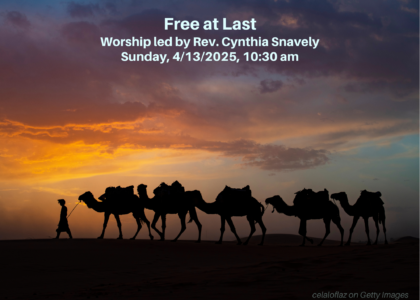
Please click the link to watch Rev. Cynthia Snavely’s video recording of this sermon.
Our theme for this month is joy, and the holidays we celebrate over this week and next—the Jewish holiday of Passover and the Christian holiday of Easter—are certainly holidays of joy. But both holidays also call us to something beyond the celebration. Neither Moses nor Jesus completed the work. There is still something for us to do. There is more justice to be sought, more compassion to share.
Passover is the celebration of the escape of the Hebrews from slavery in Egypt. The Book of Exodus says that after the people escaped by crossing the Red Sea, “Then Miriam the prophet, Aaron’s sister, took a timbrel in her hand, and all the women followed her, with timbrels and dancing.” Our closing hymn this morning has a verse that sings, “Long be our journeying, yet justice is worth it, dance, sister Miriam, and help us to birth it.”
The music to that hymn is a Hebrew folk song, but the words are written by a Unitarian Universalist minister Mark Belletini. He ends with a verse referring to the flaming bush from which God called Moses and the water that miraculously gushed from rocks when the Israelites thought they would die of thirst in the wilderness.
“O people, (not the Israelites but us), lift your heads
And look to the mountains;
Bushes aflame still call us,
Rocks still gush fountains!”
We, like Moses and the Israelites, are called and sustained in our journey. We have work to do, yes, but there is also cold, clear water to refresh and renew us.
And how can joy, dancing, singing, feasting empower us to do the work that needs to be done today? What can help us to lift our heads from all that is weighing us down so that we can answer our call?
Another Unitarian Universalist minister recently shared this with me:
Ken Wiley, radio host of “The Art of Jazz,” tells this story.
“Maya Angelou turned forty on April 4, 1968. She had planned a big party in Harlem, with many of the day’s black intellectual elite among the guests. History had other ideas; Dr. King’s assassination sent Angelou into a weeks-long depression. It was fellow writer James Baldwin who helped her dig out of it. Angelou recalls Baldwin’s assistance in her book A Song Flung Up to Heaven, where she writes that laughter and ancestral guidance got her through:
She writes, “There was very little serious conversation. The times were so solemn and the daily news so somber that we snatched mirth from unlikely places and gave servings of it to one another with both hands…
“’I told Jimmy (that would be Baldwin) I was so glad to laugh. Jimmy said, ‘We survived slavery…. You know how we survived? We put surviving into our poems and into our songs. We put it into our folk tales. We danced surviving in Congo Square in New Orleans and put it in our pots when we cooked pinto beans…. [W]e knew, if we wanted to survive, we had better lift our own spirits. So we laughed whenever we got the chance.’”
I was reminded of the chorus of a Christian gospel song by Hezekiah Walker:
“You are important to me
I need you to survive
You are important to me
I need you to survive.”
Sing, laugh, dance so that survival is possible. For us right now it may not be our individual physical survival that is at stake but our way of life, our freedoms, our democracy.
On Tuesday this week I heard Professor Jason Stanley being interviewed on “Morning Edition” on NPR. Stanley’s Wikipedia site now begins with these sentences, “Jason Stanley… is an American philosopher who is the Jacob Urowsky Professor of Philosophy at Yale University. He has accepted an appointment at the University of Toronto based on what he describes as the deteriorating political situation in the United States,” (from Jason Stanley – Wikipedia).
Further into the article it says, “Stanley is the author of several books, including How Propaganda Works (2015) and How Fascism Works (2018). As a philosopher of language and an authority on propaganda and fascism, Stanley’s work often views contemporary politics and foreign affairs through the lens of Nazi Germany and the Holocaust….
“On March 28, 2025, Stanley accepted a position at the University of Toronto’s Munk School in Canada. He stated that he left the United States due to what he perceived to be America’s descent into a fascist dictatorship,” (from Jason Stanley – Wikipedia).
In the interview on Tuesday, he said he has Black Jewish children, and he was not going to risk their safety by staying here. He also said that American Jews are being set up as scapegoats as this administration dismantles democracy in the name of protecting people from antisemitism. He says that this is a fake reason and is ultimately a way of turning others against Jews and blaming them instead of the administration for destroying our educational system (from Yale professor describes why he is leaving the U.S. to teach in Canada | Connecticut Public).
I was reminded of visiting an evangelical Christian church back in the 1990s. My daughter came to me at the age of twelve. She hated being the center of attention on Sunday mornings as the new PK, preacher’s kid. With her previous foster mother, she had attended the aforementioned evangelical Christian church. A family from that church offered to take her there on Sundays. I agreed. It seemed like it would give my daughter some consistency when much had changed in her life. On Sundays when I was not preaching, I would sometimes go with her to that church. But the day that I went and the sermon was all about needing to pray for war in the Middle East so that the Jews and Muslims would annihilate each other and the Christians could rule the land, I had had my fill. As far as I was concerned, that was not Christianity.
It is exactly that kind of Christianity, however, that our current administration has coopted. Pastor Josh McPherson says, “Empathy almost needs to be struck from the Christian vocabulary…. Empathy is dangerous. Empathy is toxic. Empathy will align you with hell.”
Who is McPherson echoing in his preaching? Elon Musk, who says, “The fundamental weakness of Western civilization is empathy….There’s so much empathy that you actually suicide yourself…. we’ve got civilizational suicidal empathy going on,” (from How empathy came to be seen as a weakness in conservative circles : NPR).
This is the same kind of reasoning displayed at Charlottesville in 2017 with the chant of “Jews will not replace us.”
On the Brandeis University website in a 2021 piece titled “The Long, Ugly Antisemitic History of ‘Jews Will Not Replace Us,’” it says, “Scholar of Jewish history Deborah Lipstadt… argued in an expert report presented to the court concerning the history, ideology, symbolism and rhetoric of antisemitism—subsequently summarized in her personal testimony—that the Charlottesville chant carried several meanings.
“’In its simplest and most straightforward interpretation,’ she explained, ‘that chant can be understood to say Jews will not replace ‘us,’ i.e., white Christians in our jobs or our dominant place in society. We as whites will remain the dominant and supreme force in society.’
“She also pointed to a ‘subtler but deeply ideological meaning to this chant,’ rooted in the fear referred to by white nationalists as the ‘great replacement’ or ‘white genocide.’ The Charlottesville chant is expressing centuries-old fears that Jews, in league with peoples of color, are engaged in a nefarious plot to destroy the white Christian civilization,” (from The Long, Ugly Antisemitic History of “Jews Will Not Replace Us” | November | 2021 | The Jewish Experience | Brandeis University).
Professor Stanley says Jews are being set up as the scapegoat to take the blame for the destruction of our institutions, but so are people of color.
This is an old story…. The first chapter of the Book of Exodus tells us, “Then a new king… came to power in Egypt. ‘Look,’ he said to his people, ‘the Israelites have become far too numerous for us.Come, we must deal shrewdly with them or they will become even more numerous….”
Today we are being told that we should fear immigrants to our country, that there are too many of them, and that their presence here is dangerous.
The story is being told that Blacks and women have unfairly claimed jobs that should be for white men. Too many of those Blacks and women are getting college educations taking places white men should have.
The people in the United States other than the Jews who claim today’s Passover story as uniquely their own also claim next week’s Easter story. In African American churches, the story of the Israelites escape from slavery is claimed as their story. The story of a man Jesus lynched after a sham trial but whose people do not give up is claimed as their story.
We are being set up not to blame the Pharoah and his court for the looting of our legacy, but to blame each other. But if we listen to the Jewish story of Passover, if we listen to the story of Black history in the United States, we will not be fooled.
In Rabbi Peter H. Schweitzer’s “The Liberated Haggadah: A Passover Celebration for Cultural, Secular and Humanistic Jews,” after the traditional four questions is another section titled “Modern Questions.” It says, “The age-old questions are devices that prompt us to tell our story. Our modern questions are catalysts for deeper discussion. What sustains Jewish people in times of crisis? How do we live our lives to affirm and preserve our human dignity? What is our moral obligation to each other—and to the stranger? Why and how do we want to maintain our Jewish identity? Why has a solution to the Middle East conflict been so difficult to achieve? How can safety and security be fostered for all parties? What can be our voice from America? What can give us renewed hope in a future of peace? Why can we get people to the moon but we cannot get the homeless adequate shelters? How can people close their eyes and ears and hearts to the suffering of others? What makes it possible for a parent to abuse a child? What makes it possible for one people to oppress another? What can we do on behalf of the downtrodden and the enslaved? How can we free ourselves from our own anxieties and fears? How can we work to bring about peace for the world? How long will we have to keep asking these questions?” (from Haggadah 2010).
In the Haggadah from the organization Jewish Voices for Peace an olive is adding to the traditional foods on the seder plate. That Haggadah includes these words.
“As we begin the Exodus story, we read that the oppression of the Israelites resulted from Pharaoh’s fear that their growth would somehow overwhelm the Egyptian nation. These verses certainly have an ominous resonance for the Jewish people. Indeed any member of a minority faith or ethnic group knows all too well the tragedy that inevitably ensues when a nation views their demographic growth as a ‘threat.’ Today it is all too common to hear Israel’s leaders and supporters suggest that the ‘Jewish character’ of Israel is threatened by the demographic growth of the Palestinian people. How should we react to the suggestion that the mere fact of this group’s growth necessarily poses a national threat to Israel? As Jews living in the Diaspora, how would we respond if our leaders raised questions about the ‘demographic threat’ of a particular minority group to the ‘national character’ of our country? In a multi-ethnic society, can a state’s identity ever be predicated upon the primacy of one ethnic group without the oppression of another? As we answer this question, pass olives around the table. When our conversation is finished, we ask: Zayit: al shum mah?—This olive: why do we eat it? The olive tree is one of the first plants mentioned in the Torah and remains among the oldest species in Israel/Palestine. It has become a universal symbol of peace and hope, as it is written in Psalm 52: ‘I am like a thriving olive tree in God’s house, I trust in God’s loyal kindness forever and ever.’ We add this olive to our seder plate as a reminder that we must all be God’s bearers of peace and hope in the world. At the same time, we eat this olive in sorrow, mindful that olive trees, the source of livelihood for Palestinian farmers, are regularly chopped down, burned and uprooted by Israeli settlers and the Israeli authorities. As we look on, Israel pursues systematic policies that increasingly deny Palestinians access to olive orchards that have belonged to them for generations. As we eat now, we ask one another: How will we, as Jews, bear witness to the unjust actions committed in our name? Will these olives inspire us to be bearers of peace and hope for Palestinians—and for all who are oppressed?” (from JVP-Haggadah-8.5×11.pdf).
The Israelites celebrated when they made it out of Egypt, but they had a forty-year walk still ahead of them. Still, there is joy at each step on the journey.
I end with these words from Nelson Mandela.
“I have walked that long road to freedom.
I have tried not to falter;
I have made missteps along the way.
But I have discovered the secret that
after climbing a great hill, one only finds
that there are many more hills to climb.
I have taken a moment here to rest,
To steal a view of the glorious vista
that surrounds me, to look back
on the distance I have come.
But I can only rest for a moment,
for with freedom come responsibilities,
and I dare not linger, for my long walk
is not ended.”
May we too join that walk, so that all may be free.
If you’ve appreciated this sermon, please text to give or visit our Give Now page to support the UUCSH Share the Plate efforts to assist those in need.