
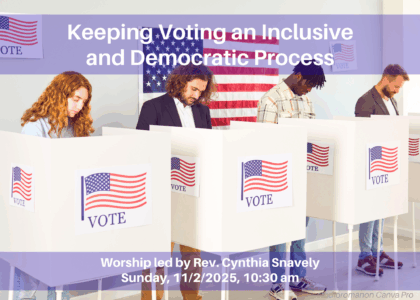
Please click the link to watch Rev. Cynthia Snavely’s video recording of this sermon.
The issue of the election this Tuesday has been filling up my email inbox this past week.
The League of Women Voters sent me an email telling me that early voting had started last Saturday and reminding me of the League’s Vote411.org website where I could get general information on voting, find out what’s on my ballot and see responses to the League’s questions from the candidates. It also told me that if I had any questions or ran into any problems, I could call the League of Women Voters of New Jersey at 1-800-792-VOTE (8683), and that the hotline would be staffed the entire time the polls are open.
The New Brunswick Area NAACP sent me an email telling me that the NAACP New Jersey State Conference has partnered with the Transformative Justice Coalition and others to bring to New Jersey the “John Lewis Let’s Vote Good Trouble Bus Tour” staffed with “freedom riders” who will provide community members with information about where registered voters can cast an early ballot, how to vote by mail, and even the location of their polling place. The bus would be in New Brunswick on this past Tuesday from 12-3, stopping at senior housing buildings, public housing, neighborhood gathering places, schools and finally on to Rutgers campus….
Karen Gaffney, who leads the monthly online Community Course on Racism on the first Tuesdays of the month, sent a reminder of the November 4 meeting and links to two recent voting-related episodes of the NPR Code Switch podcast that focuses on race. One of those links was a conversation between the host Gene Demby and Stacey Abrams, a former state lawmaker from Georgia, the first Black woman to be the nominee of a major party for a state governorship in the United States, and founder of American Pride Rises network and 10stepscampaign.org.
The last thing Abrams says in that conversation is, “People lose hope when democracy doesn’t work, and they think it doesn’t work when their needs aren’t met. And so, one of our responsibilities is to prove that democracy can deliver. That’s why I focus so aggressively on local government, because people actually do want government to work. They do want to be able to send their kids to school and make sure that they are getting what they need. They do want to be able to go to the doctor when they need to. They want their hospitals to be available. They want their roads and bridges to work. They want good things to happen for their communities.
“And what has happened is that we have broken not just the trust, but the link between what government should deliver and what people should expect and how we get there. And so knowing that that’s the problem, I chafe against the idea that the answer is to not vote. When I have paid my money, I want my service. Every American has paid their taxes. If you’ve bought a stick of gum, you’ve paid your taxes. So you should be demanding the government you deserve. And that’s why, while this moment is fraught and treacherous and terrible, it’s also an opportunity for us to renew what democracy should actually mean to demand the government that we deserve.
“There are many ways we can get the government we deserve, but voting is the way we do it. In a democracy, you got to show up. And if you don’t show up, the people who want you to be silent are going to use your silence as consent. And so what I tell folks is, you may not be into politics, but politics is into you. And it is a stalker. And so you can either let your stalker win or you can get the restraining order, which is going to vote and getting them out of office. You can show up at their jobs and tell them you see them, and we can demand the democracy and the country we deserve,” (Stacey Abrams on how voter suppression threatens democracy: Code Switch: NPR).
It can be very easy right now to be disillusioned and to think your vote doesn’t make a difference, that your calls and letters to your local, state and national government officials make no difference, but if we stop voting, if we stop calling and writing, we have surrendered our democracy. That would be a dishonoring of one of our Unitarian Universalist values: “Justice. We work to be diverse multicultural Beloved Communities where all thrive. We covenant to dismantle racism and all forms of systemic oppression. We support the use of inclusive democratic processes to make decisions within our congregations, our Association, and society at large.”
A few years ago, when I was serving as interim minister with two congregations in Florida, the president of one of the congregations, an avid reader and lover of books, suggested that we do an online book study of the book version of The 1619 Project. There are 18 chapters of essays and readings. We considered one a week for eighteen weeks. That is longer than many people are willing to commit to a book study, but about twenty people participated, some from the congregation and a number from the local American Association of University Women who promoted the study through their Diversity, Equity and Inclusion Committee. We learned some history from the days of colonial America to the present from a Black perspective, a view that many of us did not get in our schoolbooks, and a view that—unfortunately—is being suppressed today.
Chapter 7 in The 1619 Project is titled “Politics.” It is by New York Times opinion columnist Jamelle Bouie. It begins, “Early on the morning of November 4, 2020, with millions of votes still outstanding in the states that would determine the election, President Donald Trump declared victory.
“’I want to thank the American people for their tremendous support,’ he began. ‘Millions and millions of people voted for us tonight. And a very sad group of people is trying to disenfranchise that group of people and we won’t stand for it.’
“We will not stand for it. Over the following weeks and months, Trump’s legal team mounted dozens of lawsuits aimed at throwing out votes that had been cast for his opponent, Joe Biden, and overturning the election in Trump’s favor. ‘If you count the legal votes, I easily win,’ he said in a White House speech. ‘If you count the illegal votes, they can try to steal the election from us….’
“After Trump lost, with the majority of mail-in ballots going to his opponent, his campaign argued that illegal voting had been particularly rampant in a few cities within the states that had determined the election: Atlanta, Detroit, Philadelphia, and Milwaukee.
“No one has ever accused Donald Trump of being subtle, but even for him, this was blatant. Atlanta is 51 percent Black, Detroit 78 percent, Philadelphia is 42 percent, and Milwaukee has a Black population of just under 39 percent. So-called illegal votes were, in actuality, just Black votes. This wasn’t about election integrity; it was about casting Black voters as politically illegitimate. As the NAACP Legal Defense Fund said in a lawsuit representing a group of Michigan voters against the Trump campaign, ‘Defendant’s tactics repeat the worst abuses in our nation’s history.’”
Let me tell you about how I ended up regularly hearing about those historic abuses. After the Florida book study of The 1619 Project, the congregation worked with AAA to organize a bus trip to Montgomery, Alabama. We saw the Civil Rights Museum, the Rosa Parks Museum, and the Equal Justice Initiative’s Legacy sites, which include the Legacy Museum, the Freedom Monument Sculpture Park, and The National Memorial for Peace and Justice. Some of us, including me, signed up for the daily History of Racial Injustice emails from the Equal Justice Initiative. It is sad how many of them involve violent suppression of the Black vote.
This Monday, this email recounted, “On October 27, 1868, mobs of white people continued a massacre of at least 35 Black people in St. Bernard Parish, Louisiana, days before the presidential election. The terror campaign succeeded in suppressing Black political participation in the parish.
“In 1868, the majority of people living in St. Bernard Parish, a plantation community located just outside New Orleans, were formerly enslaved Black people. At the beginning of the Reconstruction era—the period of legal, political, and social re-creation that followed the Civil War—the Fourteenth and Fifteenth Amendments guaranteed Black men the right to vote. As a result, Black people comprised the decisive bloc of voters in St. Bernard Parish for the first time.
“The 1868 presidential election was the first after the end of the Civil War. In it, Republican candidate and former Union Gen. Ulysses S. Grant, who had led the Union Army to victory and championed Reconstruction, faced Democrat Horatio Seymour, who promised to halt Reconstruction, restore states’ rights, and allow states to determine voting rights for their citizens.
“In 1868, Seymour billed himself as the ‘white man’s’ candidate and accused his opponent, Ulysses Grant, of standing for ‘Negro supremacy.’ Seymour infamously campaigned on the slogan ‘This is a white man’s country: Let white men rule.’
“On October 25, days before the election, Seymour supporters—who were vastly outnumbered in St. Bernard Parish—took up arms and held a demonstration. As they marched past a Black citizen named Eugene Lock, they demanded that he cheer for Seymour. When Mr. Lock refused, they shot and stabbed him to death.
“Rightly fearing that Mr. Lock’s death, as well as the mob’s subsequent killing of a white police officer who had fought in the Union Army, would lead to mass killings of Black people, many Black residents fled their homes. Over the next three days, mobs of armed white Seymour supporters violently rioted against the Black residents who stayed….
“By the time federal troops arrived to quell the violence, at least 35 Black people had been killed. Some sources suggest this number was significantly higher.
“The mob succeeded in suppressing the Black vote. Ulysses S. Grant received only a single vote in St. Bernard Parish despite its Republican majority.
“No mob member was ever arrested or held accountable for their participation in the massacre,” (On Oct 27, 1868: Mobs of White People Massacre At Least 35 Black People in St. Bernard Parish, Louisiana).
Earlier in October, some more recent history was recounted in the History of Racial Injustice email of the day:
“On October 7, 1963, hundreds of Black Selma residents attempting to register to vote were met by state and local officials who used stalling, intimidation tactics, and violence to deny them that right. The law enforcement officers also harassed and attacked supporters attempting to give those attempting to register food and water as they waited in line.
“In 1963, representatives of civil rights organizations such as the Student Non-Violent Coordinating Committee (SNCC) and the Dallas County Voter’s League (DCVL) organized Black residents of Selma, Alabama, to challenge discriminatory voter registration practices. At the time, Dallas County was 58% Black, but less than 1% of eligible Black residents were registered to vote. During 1963, Dallas County Sheriff Jim Clark met their voter registration efforts with harassment and violent resistance, joined by other local law enforcement officers and segregationist supporters who participated in violence against Black residents with impunity. Hundreds of Black residents were arrested, beaten, or threatened in Selma during the first half of 1963.
“On the morning of October 7, on what SNCC and DCVL called ‘Freedom Day,’ 350 Black residents of Selma bravely lined up at the county courthouse—risking their livelihoods—and attempted to register to vote. The registrars intentionally slowed down the proceedings, limiting registration to only a few people every hour and ensuring that only a small handful of those waiting in line would be able to register. Sheriff Clark, his deputies, and supporters forbade Freedom Day participants from leaving the line to eat, drink, or use the restroom.
“At 12:30 pm, a group of 40 state troopers arrived and assisted local law enforcement in intimidating the Freedom Day participants. Because those waiting to register to vote could not leave the line to eat or drink, at one point, a group of organizers attempted to bring food and water to the Black residents waiting in line. These organizers were beaten and shocked with cattle prods by the state and local officials. A reporter was also beaten by state troopers. Representatives of the FBI and the Department of Justice witnessed these unlawful attacks but did nothing to intervene,” (On Oct 07, 1963: Alabama Troopers Attack Black People Registering to Vote in Selma).
In my little preview video for this service, I told a little more of the history of the 1963 work for voting rights, including the death of civil rights activist and Baptist deacon Jimmie Lee Jackson, the planned march from Selma to Montgomery, Bloody Sunday, Dr. King’s call for people of faith from across the country to come and join the march, and the deaths of two of our own; Unitarian Universalist minister the Rev. James Reeb and Unitarian Universalist laywoman Viola Liuzzo as they answered that call.
It can be very easy right now to be disillusioned and to think your vote doesn’t make a difference, but if we stop voting we have surrendered the democracy for which so many have worked and died, some of whose names we know; Jimmie Lee Jackson, Dr. Martin Luther King, Jr., Medgar Evers, Rev. James Reeb, Viola Liuzza, and many whose names we do not know and remember. May we not dishonor them or that Unitarian Universalist value, Justice. Democracy is only ours if we do the work to keep it.
I end with a reading by Unitarian Universalist minister Lucas Hergert:
We are democracy—unruly, unfinished, unrelenting
people of rebellious joy taking to the streets
underground resilience resisting complaisance
the pleasure of activism organizing into simple hope
we are democracy,
people of principles taking on principalities
witnessing the worth of those called unworthy
justice just now gaining ground
integrity of interdependent existence extending
living democracy in heads hands hearts
we know that democracy can die, ossify
brittle byproducts of bygone idealists
plotting politicians pirating votes
corporations cannibalizing our care for the world
look: it can wither, distend, come to an end
democracy, today we will love you alive
make you ours, make you thrive
and vote as though our hope is on the line.
If you’ve appreciated this sermon, please visit our Give Now page to support the UUCSH Share the Plate efforts to assist those in need.