
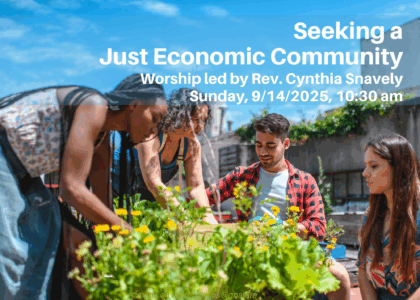
Please click the link to watch Rev. Cynthia Snavely’s video recording of this sermon.
Let me begin with a quote. “Labor is prior to–and independent of—capital. Capital is only the fruit of labor, and could never have existed if labor had not first existed. Labor is the superior of capital, and deserves much the higher consideration,” stated Abraham Lincoln.
An interesting quote at an interesting time, for it was only in Lincoln’s time that a good deal of American labor was finally—but unfortunately not fully—to be considered as human beings and not as capital.
In Matthew Desmond’s essay “Capitalism,” in The 1619 Project, he writes, “In a capitalist society like ours, wages are depressed as businesses compete over the price, not the quality, of goods, and so-called unskilled workers are typically incentivized through punishments, not promotions. Inequality reigns and poverty spreads.
“The United States stands today as one of the most unequal societies in the history of the world. The richest 1 percent of Americans owns 40 percent of the country’s wealth, while a larger share of working-age people (those 18 to 65) live in poverty than in any other nation belonging to Organization for Economic Co-operation and Development (OECD)….
“Those searching for reasons the American economy is uniquely severe and unbridled have found answers in many places (religion, politics, culture). But recently, historians have pointed persuasively to the gnatty fields of Georgia and Alabama, to the cotton houses and auction blocks, as an early example of America’s low-road approach to capitalism.
“As a source of the fledgling nation’s financial might, slavery shaped our political institutions and founding documents, our laws governing private property and financial regulation, our management techniques and accounting systems, and our economic systems and labor unions. By the eve of the Civil War, the Mississippi Valley was home to more millionaires per capita than anywhere else in the United States. Cotton grown and picked by enslaved workers was the nation’s most valuable export. The combined value of enslaved people exceeded that of all the railroads and factories in the nation.”
A way of seeing workers as capital before human beings was early ingrained into America’s way of being. Clara Lemlich came to America from the town of Gorodok—then in Russia, now in Ukraine—in 1903. The Wikipedia article on Clara Lemlich says, “Lemlich was able to find a job in the garment industry upon her arrival in New York. Conditions there had become even worse since the turn of the century, as the new industrial sewing machine allowed employers to demand twice as much production from their employees, who often had to supply their own machines and carry them to and from work. Lemlich, along with many of her co-workers, rebelled against the long hours, low pay, lack of opportunities for advancement, and humiliating treatment from supervisors,” (from Clara Lemlich – Wikipedia).
Economic systems get tied up with politics. On the British economist Paul Boyce’s website Boycewire, he describes the American economy not as fully capitalist, but as mixed.
“The US, like the UK, is a mixed economy. The federal government owns entities like Amtrak, Fannie Mae, and Freddie Mac, while state governments own entities such as Alascom, New York Port Authority, and TVA. Although the majority of resources are owned by private enterprises, the government controls about 38% of the nation’s GDP (Gross Domestic Product). This means the US government decides where nearly 40% of the nation’s economic output goes, with a significant portion going towards the military,” (from Economic System: (Definition, 4 Types & 3 Examples).
Clara Lemlich knew how much politics and economics were connected. Again, from Wikipedia, “Blacklisted from the (garment) industry and at odds with the conservative leadership of the (International Ladies’ Garment Worker Union) ILGWU, Lemlich devoted herself to the campaign for women’s suffrage…. Lemlich portrayed women’s suffrage as necessary for the improvement of working women’s lives, both inside and outside the workplace.
She said, “The manufacturer has a vote; the bosses have votes; the foremen have votes, the inspectors have votes. The working girl has no vote. When she asks to have a building in which she must work made clean and safe, the officials do not have to listen. When she asks not to work such long hours, they do not have to listen…. [U]ntil the men in the Legislature at Albany represent her as well as the bosses and the foremen, she will not get justice; she will not get fair conditions. That is why the working woman now says that she must have the vote,” (from Clara Lemlich – Wikipedia).
When Lemlich married in 1913, she mostly stopped working outside the home. That did not mean, however, that she stopped thinking about economics OR that she stopped organizing.
From Wikipedia: “…for the next thirty years. … she devoted herself to raising a family and organizing housewives.
… After joining the Communist Party,… Lemlich and Kate Gitlow… attempted to organize a union of housewives that would address not only consumers’ issues, but housing and education as well. The United Council of Working Class Housewives also raised money and organized relief for strikers in Passaic, New Jersey during the bitter 1926 strike.
“In 1929, after the Communist Party created a Women’s Commission, Lemlich launched the United Council of Working-Class Women (UCWW), which eventually had nearly fifty branches in New York City, as well as affiliates in Philadelphia, Seattle, Chicago, Los Angeles, San Francisco, and Detroit. …The… UCWW led a widespread boycott of butcher shops to protest high meat prices in 1935, using the militant tactics of flying squadrons of picketers that shut down more than 4,000 butcher shops in New York City. The strike became nationwide and the UCWW won support outside the Jewish and African-American communities to which it had been limited in New York.
“The UCWW renamed itself the Progressive Women’s Councils the following years as part of the Popular Front politics of the day. The Party withdrew support for the councils and discontinued publications aimed at women, however, in 1938. Lemlich continued to be active in the PWC, however, and was a local leader in it after it affiliated with the International Worker’s Order in the 1940s. The Councils organized even broader boycotts to protest high prices in 1948 and 1951, before accusations of Communist Party dominance destroyed it in the early 1950s. The IWO was ordered dissolved by the state of New York in 1952,” (from Clara Lemlich – Wikipedia).
Just because the International Workers Order no longer existed didn’t mean Clara Lemlich was done.
“Lemlich continued her activities as part of the Emma Lazarus Federation of Jewish Women’s Clubs, which raised funds for Red Mogen David, protested nuclear weapons, campaigned for ratification of the United Nations’ Convention on Genocide, opposed the War in Vietnam, and forged alliances with Sojourners for Truth, an African-American women’s civil rights organization.
“Lemlich was also active in Unemployed Councils activities and in founding the Emma Lazarus Council, which supported tenant rights,” (from Clara Lemlich – Wikipedia).
Lemlich never retired from seeking a more just economic community. “At age 81, she entered the Jewish Home for the Aged in Los Angeles. As a resident, she persuaded the management to join in the United Farm Workers boycotts of grapes and lettuce and helped the orderlies there to organize a labor union,” (from Clara Lemlich – Wikipedia).
And she can be a model for all of us. None of us can do everything, but all of us can do something. There is a Unitarian Universalists affiliated group called Unitarian Universalists for a Just Economic Community. On the About Us portion of their website, they say, “Our current focus is challenging corporate dominance, with our members and allies participating and leading actions to raise the minimum wage, support community banks, credit unions & cooperatives, promote single-payer healthcare, estate tax reform, amending the constitution to remove ‘corporate personhood,’ opposing unfair trade and globalization and ensuring access to available and affordable resources for all,” (from About Us—UUJEC).
Obviously, no one person is doing all of that. No one person may even agree that all of that is what should be done.
Those of you who belong to Citizens’ Climate Lobby may be concentrating on working for an economy that doesn’t destroy the planet and that doesn’t sicken the poorest and most vulnerable among us. Those of you who volunteer with Literacy Volunteers of Somerset County may be concentrating on making sure people have the skills they need to get ahead. Those of you who are part of the Giving Network may be working to be sure people have the basic items and food they need. Each of us has a part to play in creating a just economy.
I used the example of Clara Lemlich today, but I could have used a more recent and more local example. In an autobiography written by our own soon-to-be-99-year-old member June Adams, she writes of her time at the University of California, “I organized a union of working students. Made speeches at Sather Gate. (Originally, the gate served as the terminus of Telegraph Avenue and marked the University’s south entrance.) I organized a strike against a restaurant that clearly discriminated against Black students who would be waiting to be seated. For one day, no one crossed. The administration pulled us away after that. I think people were seated properly after that.”
From Article II of the Unitarian Universalist Association Bylaws, “Love is the power that holds us together and is at the center of our shared values. We are accountable to one another for doing the work of living our shared values through the spiritual discipline of Love. Inseparable from one another, these shared values are:… (And there is a list, but the value I lift up today is) ‘Equity. We declare that every person is inherently worthy and has the right to flourish with dignity, love, and compassion. We covenant to use our time, wisdom, attention, and money to build and sustain fully accessible and inclusive communities,’” (from Article_II_Purposes_and_Covenant_Final_as_of_GA_2024.pdf).
I end with a prayer by Unitarian Universalist minister of faith formation Dayna Edwards.
“Spirit of Life and Love,
Times are tough and trepidation swirls in our hearts.
Groceries are expensive and our paychecks don’t go as far as they used to.
Incendiary words drip off the lips of our politicians and sow division in our nation.
People we loved are lost to hateful rhetoric and dubious conspiracy theories.
And still there is hope.
Through the generations, our democracy has been threatened, questioned, and buffeted.
Our government has not always lived up to its ideal of freedom for all.
We are grateful for all those organizers, journalists, freedom fighters, clergy,
and regular people who knew that the people of our nation
are called to do better and be better.
Those like Grace Lee Boggs, Fannie Lou Hamer, Ida B. Wells,
Dolores Huerta, Harriet Tubman, Viola Liuzzo, [Clara Lemlich],
and so many others who knew that freedom isn’t free,
who saw the deep and intricate connections of the human web,
who cared enough to show up and keep showing up,
who loved the people of this nation enough to keep fighting for who we could be.
They gave us hope.
They gave us hope that even though our democracy isn’t perfect,
striving toward excellence in the way we care for the people of this nation,
serve the people of this nation,
and govern the people of this nation
is a worthy and noble cause.
Our faith also gives us hope.
A faith that knows that transformation is a holy and sacred task,
that affirms that the democratic process is a faithful act,
that brings a generous heart and a lens of justice and liberation to all that we do,
that values equality and equity and is centered in love.
Our love gives us hope.
A revolutionary love that challenges us to find the worth and dignity in those with whom we disagree,
love that inspires us to amplify the voices that are often silenced,
love that holds us when the work of liberation seems so daunting,
a love so big it bears the heavy weight of complex humans with ease.
Spirit of life,
May love, hope, and wisdom guide us in our lifelong work toward liberation.
May it be so. Amen and blessed be.”
If you’ve appreciated this sermon, please text to give or visit our Give Now page to support the UUCSH Share the Plate efforts to assist those in need.