
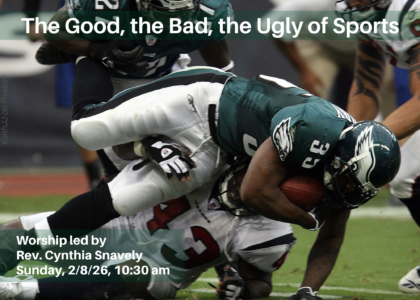
Please click the link to watch Rev. Cynthia Snavely’s video recording of this sermon.
Twentieth-century American Major League Baseball right fielder and manager Casey Stengel said, “Finding good players is easy. Getting them to play as a team is another story.”
I thought about that quote. No one succeeds in sports or in life alone. Even those athletes whose sport we think of as an individual endeavor need others. The race car driver needs their pit crew. The marathon runner depends on pacers and individuals staffing aid stations and vehicles. The person swimming the English Channel needs a safety team. The ice skater needs the Zamboni driver.
I have to admit that there are moments when I feel done with the human race and say I am ready to go live as a hermit on some remote mountaintop, but I know I would neither enjoy, nor for that matter, survive in such an isolated existence. We need one another, and that is one of the good things that sports can teach us.
I did not grow up in a sports-minded family. My maternal grandmother was the only big sports fan. Baseball was her favorite. The Philadelphia Phillies were her team. But she would watch football and basketball too, and she regularly took us to the Hershey Bears’ hockey games. Due to Parkinson’s disease and osteoporosis that meant a broken hip didn’t heal, she spent the last years of her life in a nursing home.
After she had spent about a year being pretty much unable to take in or to communicate much, her medications were readjusted. For about a year she was back. One of the first things she commented on was a baseball game she was watching. She didn’t know one of the teams. The team was new. It had formed in her lost year.
Even as she slid back into dementia, sports remained important. One evening she complained of being very tired. When asked why she was so tired, my grandmother, who couldn’t get out of her bed, said she had been playing football all day. Apparently, even toward the end, she was in some way enjoying the sport.
In my short video preview for today’s service, I described how my friend Don found friends after his family moved. He had begun life in a coal mining town in the mountains of West Virginia. When the company closed the mine, everyone in the coal company town had to move. Don’s family moved down the mountain into a little town closer to the state capital of Charleston. Don’s mother found a house on the Black side of town, but right on the border with the white side. When Don went out to play, he found a bunch of white boys playing football. He asked if he, a Black boy, could play. They said yes, and when he scored a touchdown, he was in. He had new friends.
Don is really retired now, but when he retired early from his job as a DC social worker, he studied for the Unitarian Universalist ministry, not to serve a congregation, but in order to have the respected title of “Rev” as he began a community ministry at Edgewood Terrace, a low-income housing project in DC.
When he began, it was him in an empty apartment, providing homework help and snacks. The food was what drew the kids in. He remembers, back then, seeing kids eating discarded French fries out of the gutter.
These days, Beacon House Community Ministry, the program he founded, still provides food, but it is often the sports that draw the kids in.
On the Beacon House webpage, the history of the program is outlined: “1991: Beacon House was founded by Reverend Donald E. Robinson, an ordained Unitarian Universalist minister known affectionately as ‘Rev.’ Rev provided homework help to a dozen children in a basement apartment in the Edgewood neighborhood of Northeast DC’s Ward 5 with the support of the Edgewood residents and the Washington, D.C. metropolitan area Unitarian Universalist churches. Reverend Robinson retired from Beacon House in the summer of 2017.”
“1999: Beacon House expanded our programs into athletics. Our Athletics Director, Rodney Cephas, established the program to engage Edgewood children in various activities that motivated them to stay engaged at school and kept them out of trouble.
“2019: Our Athletics Program celebrated its 20th year. What began with one football team has now transformed into a program that serves 340 boys and girls annually in multiple seasonal sports.”
Today, The Athletics Program Page of the website says, “Our Athletics Program serves over 300 girls and boys annually in football, basketball, baseball, softball, and competitive cheerleading. Our student-athletes must demonstrate a commitment to their schoolwork to be eligible to practice and play.
“Athletics are a critical part of our education-focused mission, as it encourages academic accomplishments and social-emotional growth. Students’ participation promotes connectedness, increased resilience, and a greater ability to resist peer pressure. It has become a power vehicle for youth development….’
“Athletics often provides a path to college for many of our participants. Longtime volunteer Robert Wade Jr. described how our Athletics Program reinforces the importance of school: ‘We emphasize education—preach it first. We set an expectation that they will do well in school. We tell our youth that if you can learn on the court or the field, then you can learn in school.’”
One of the endorsements that is included in those that scroll through the website’s homepage says, “’My character has been shaped through their influence and the game of football, and I have learned integrity, dedication and leadership,’ Kareem, Beacon House Program Alumnus,” (from Beacon House – Where Learning Has a Home).
That all seems like a complete endorsement of sports. But I know there is a negative side as well. After all, I was the fat little kid who always got picked last for a team. My mother did not encourage me to learn or to try. She just said, “Oh, you are clumsy like me.”
And then, on the other hand, there were the kids who were great at sports, whose parents pushed them hard and expected nothing but successful home runs, baskets, touchdowns, and berated them when they failed. That wasn’t any better.
For our opening words, I used the quote from Michael Jordan in which he said, “I’ve missed more than 9000 shots in my career. I’ve lost almost 300 games. Twenty-six times, I’ve been trusted to take the game winning shot and missed. I’ve failed over and over and over again in my life. And that is why I succeed.”
Learning to fail and being willing to try again is part of the good of sports.
Today we are learning more about chronic traumatic encephalopathy (CTE), aprogressive neurodegenerative condition in the brain. Wikipedia notes, “Most documented cases have occurred in athletes with mild repetitive head impacts (RHI) over an extended period. Evidence indicates that repetitive concussive and subconcussive blows to the head cause CTE. In particular, it is associated with contact sports such as boxing, American football, Australian rules football, wrestling, mixed martial arts, ice hockey, rugby, and association football,” (from Chronic traumatic encephalopathy in sports – Wikipedia).
For too long, and still sometimes today, an athlete was/is applauded for getting right back into the game after they were/are hurt. That is not just bad, that is ugly. Dementia and suicides should not be the price of playing competitive sports.
Sports betting has become ubiquitous. I can’t watch a show or play an online game without being inundated with ads for ways I can bet on sports. That can lead to more ways to develop a gambling addiction and to cheating.
On October 24, 2025, Jenny Vrentas began a piece in The New York Times like this: “The signs that gambling has become embedded in American sports culture are impossible to miss. Sportsbooks have set up shop at stadiums; televised games include prods to bet during the action; and star athletes like LeBron James promote gambling companies as ‘talent ambassadors.’
“In the seven years since a Supreme Court decision cleared the way for legalized sports betting, the major U.S. sports leagues have shed any hesitations they had about gambling. They are now profiting—to the tune of hundreds of millions of dollars a year—from partnerships with sports betting companies.
“Team owners have made the calculation that the financial upside is worth ‘the potential expected likely loss if some form of scandal were to come up,’ said Marc Edelman, a law professor and director of sports ethics at Baruch College in New York. ‘But who’s to say whether or not that’s a rational conclusion?’”
The introduction to that article ended with, “That is the question that American sports leagues are now reckoning with after federal authorities on Thursday revealed details in a wide-ranging criminal sports betting investigation nicknamed ‘Nothing but Bet,’” (from N.B.A. Gambling Scandal Reflects America’s Obsession With Sports Betting – The New York Times).
Knowing that there are negatives to sports, how do we avoid the bad and the ugly and keep the good?
Kareem, that Beacon House alum, said he learned integrity, dedication and leadership. I think integrity is the key. Without integrity, one cannot be a good leader, and without integrity, one may become dedicated to the wrong things.
With integrity, one knows to pass the ball when that is best for the team rather holding onto it so that in order to be the hero to make the touchdown or the basket. With integrity, one is dedicated to doing what is best for everyone, even if that means the team’s star player needs to leave the game to recover from an injury. With integrity, one knows that even if sports are your livelihood, there are some things more important than a game.
As we watch the Super Bowl and the Winter Olympics, let’s take some time to consider what is beautiful and good and what needs to change for the good of the athletes and the fans.
You will hear these words again as our benediction, but I think they are worth hearing twice: “Thirty-fourth President of the United States, Dwight D. Eisenhower, said, ‘The supreme quality for leadership is unquestionably integrity. Without it, no real success is possible, no matter whether it is on a section gang, a football field, in an army, or in an office.’”
At their best, sports can teach us that.
If you’ve appreciated this sermon, please visit our Give Now page to support the UUCSH Share the Plate efforts to assist those in need.