
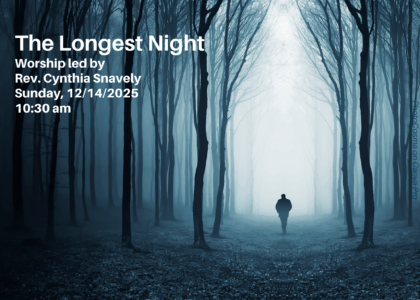
Please click the link to watch Rev. Cynthia Snavely’s video recording of this sermon.
Reading: Litany of Comfort for Blue Christmas | WorshipWeb | UUA.org
It was a tradition in one of the Florida congregations I served to hold a Blue Christmas service in December for those for whom this was not a happy time of year.
In 2022, when Christmas Day was on a Sunday, I began the sermon for that service like this: “I am not usually blue at Christmas, but this year I am a bit. There are a few reasons.
One: I hate when Christmas Day is Sunday. My experience in the past has been that the Sunday service that day is me and three people. Everyone else came for Christmas Eve and is now home enjoying watching children open presents or sleeping in or having a nice Christmas Brunch.
Two: My daughter and grandsons are away, having gone to Maryland for the holiday so that the boys could spend time with their dad.
Three: I was originally going to take the week between Christmas and New Year’s as vacation and go home to Pennsylvania. But now my mother has died and there is no reason to go. My brother and his family will be in North Carolina with my sister-in-law’s parents, and I don’t need to drive 16 hours to play Rummy-O with my sister.” 2022 was the year my mother had died at the end of October.
Most of the sad Christmas songs are about being without someone, as I was newly without my mother. The couple broke up or one person is far away or gone, but there are many more reasons than that that one might be feeling blue at Christmas.
It seems you are the only Jew, Muslim, Hindu, Buddhist, atheist in the neighborhood, and though you are not going to change your beliefs you feel left out.
You wanted to do Christmas up right this year with a beautiful tree and wonderful presents, and then the car died and all the money you had saved for the holiday went into a new transmission.
You always sent all the grandchildren a generous Christmas gift check, but this year and probably on into the future you can no longer do it. You are sad, and you don’t know quite what you should tell them.
You and a relative are on the outs. You don’t know whether you should show up at the family Christmas, whether you will be welcome, or what might happen if you and that relative are both there.
Your family expects you for Christmas, but they have never accepted that you are gay, and your lover is not welcome. You are still debating whether to go or not go.
You always host the family Christmas gathering but it is a lot of work, and you aren’t as young as you used to be. You don’t know whether you can do it. You need help, but you don’t know how to ask.
You have finally developed healthier eating habits, but you know your mother is going to expect you to eat some of all five of the kinds of cookies and three pies she has made.
Or back to where I began, maybe you divorced this year, or a spouse died, or a parent, or you just seem to be the only person in your group of family and friends who is single. You haven’t been invited anywhere, and you don’t know who you would ask if you hosted.
None of these reasons for being blue is going to be “fixed.” They are what they are. It is up to us to decide how we are going to deal with them and to be content with our choices. And let me assure you that you are the only one who needs to be content with your choice. Your choice may not bring you happiness, but it should assure you of your own strength and ability.
There is a gospel song written by Hezekiah Walker sung in many Black churches, titled “I Need You to Survive.” Some of the lines include the words “You are important to me, I need you to survive,” and “I love you. I need you to survive.”
Whatever you are going through this season there are people gathered here with you today who believe you are important and who love you. We need you to survive.
Blue Christmas services are often held around the winter solstice, because not only is the solstice the shortest day, it is also the longest night. Those of us gathered here can help you get through whatever is your longest night, but to do that we need to know what you are going through.
United Methodist minister Rev. Brandee Jasmine Mimitzraiem wrote an Advent reflection a few years ago of her own particular darkness. She wrote, “The crimson of Christmas-to-come can carry a different meaning for the infertile. Hidden in the shadows of city sidewalks, behind the anticipation of the birth of the Child so easily conceived, Advent for infertile and low-fertility women can come with the silent dread of seeing a crimson ribbon where none should be.
“I went home for Christmas, after a compassionless OB/GYN giddily announced that I would not be burdened with the ability to conceive children, on crutches. I was moving too fast, carrying too much, and had rolled down a flight of marble stairs. I couldn’t navigate the shopping malls or the piles of snow. I stayed behind while my family members went out. The babysitter. The aunty who could not have her own. Resigned to her fate.
“Somehow, we all managed to get to church on the third Sunday of Advent. My mom’s pastor preached the first reading, Zechariah 9:9. ‘Rejoice,’ he said, ‘for everything you desire is coming soon. Be joyful in the expectation of your wildest dreams coming true.’ I hobbled back to my mom’s house, with two sprained ankles and a torn meniscus, feeling the pain of ovaries wrapped in cysts and a uterus that the doctor said would remain empty, and I wondered where the joy was for me, who deeply desired children, but whose physician rejoicingly declared that I would not be one of the scores of Black women who would ‘suffer through that.’ I felt defeated, invisible, and no matter how many times I heard the words ‘rejoice, O Daughter’ ring from my mom’s recording of Handel’s Messiah (or its Joyful Celebration), I could find no cause for rejoicing.”
Mimitzraiem says that the next Christmas, “…somewhere deep behind the jingles of joy, I found a trove of sad holiday music. It was a community of tears, and there, I found the possibility of rejoicing. I rejoiced—not in spite of what I lost, not because of the possible fulfillment of all I dreamed, not because of a new hope found—because my pain was shared and vocalized. I was no longer alone….”
Another United Methodist the Rev. Dr. Susan Henry-Crowe began an email during a holiday season a few years ago with this quote from Jack Boozer, Professor of Religion, Emory University and community activist (1918-1989): “In this strange season when we are suspended between realization and expectation, may we be found honest about the darkness and perceptive of the light.”
Rev. Henry-Crowe then continued, “….In a world of war and conflict, 150 million people worldwide living in homelessness, three percent of the world’s population migrating because of climate change, poverty, pandemics and inadequate access to health care, and an epidemic of violence, it is a dark time. Imagining any light seeping through is difficult. The eradication of injustice, disease, racism, poverty, war, conflict, violence and inequality seems very far off.
But Professor Boozer said, “May we be found honest about the darkness and perceptive of the light.”
The poet Mary Oliver said, “Someone I loved once gave me a box full of darkness. It took me years to understand that this too, was a gift.” It is from within the darkness that a pinpoint of light may best be seen.
We may not feel it is possible to see any light at all after the death of a spouse, a child, a friend. We may ask “What light can there possibly be?” after we just had a feared dementia diagnosis confirmed. Where is the light in realizing we are going to outlive our funds? Personally, and globally, there is plenty of darkness in this world, but as Mary Oliver realized sometimes, darkness is a gift. The 13th-century Persian Sufi poet Rumi said, “What hurts you blesses you. Darkness is your candle.”
One of my favorite poems by turn of the twentieth-century Lebanese-American writer and poet Kahlil Gibran is his “On Joy and Sorrow.”
He wrote:
“Your joy is your sorrow unmasked.
And the selfsame well from which your laughter rises was oftentimes filled with your tears.
And how else can it be?
The deeper that sorrow carves into your being, the more joy you can contain.
Is not the cup that holds your wine the very cup that was burned in the potter’s oven?
And is not the lute that soothes your spirit, the very wood that was hollowed with knives?
When you are joyous, look deep into your heart and you shall find it is only that which has given you sorrow that is giving you joy.
When you are sorrowful look again in your heart, and you shall see that in truth you are weeping for that which has been your delight.
“Some of you say, ‘Joy is greater than sorrow,’ and others say, ‘Nay, sorrow is the greater.’
But I say unto you, they are inseparable.
Together they come, and when one sits alone with you at your board, remember that the other is asleep upon your bed.”
In your longest nights, do not sit alone with your sorrow. We are here for you. To quote Hezekiah Walker’s gospel song again,
“I love you
I need you to survive
I won’t harm you
With words from my mouth
I love you
I need you to survive.”
I end with a prayer adapted from words by Quentin Chin.
“We look to (each other) for compassion
and thank each other for our presence together this (morning).
Overwhelmed by our burdens we easily forget
that we are not alone
and that there are those who care for us and about us.
By coming together, we find assurance and comfort
that we do not suffer this season alone.
From each other’s presence we derive strength.
May we also reach out to those not here (today) for whom the season is also long.
May we be a healing presence in each other’s lives
bringing compassion and comfort
and assurance that we do not suffer alone. Amen.
If you’ve appreciated this sermon, please visit our Give Now page to support the UUCSH Share the Plate efforts to assist those in need.